2months together
- Interviews and workshopsOperators and their journeys
- Prototype and roadmapMockups, tech assessment, plan
What we did
- Product DiscoveryTwo weeks to turn a factory monitoring proof of concept into a scoped plan and roadmap.
- UI/UX DesignOperator interviews and a prototype with one dashboard, clearer tickets and autosave.
- Web DevelopmentA tech assessment of integrations and architecture, ready to scale across LATAM factories.
Unilever is one of the world’s largest consumer goods companies, founded over 100 years ago. This is how we shaped factory efficiency software for its Home Care division.
Its factories had no real-time view of production slowdowns and equipment downtime. Machine failures went unnoticed until production stopped, which meant longer repairs, late deliveries and lost revenue.
Through a Product Discovery, we designed a system that combines web development and UX practice to monitor the factories, so issues are caught at once and fixed sooner.
About Unilever
190
countries where Unilever operates.
128,000
employees worldwide.
300
company-owned factories.
20%
of total revenue from Home Care, one of its five business divisions.
Its 2023 annual report puts the focus on faster growth, higher productivity and simpler operations.
The challenge: scaling to Latin America
Unilever wanted to turn its production optimization system from a promising local experiment into a dependable, enterprise-grade product for Home Care across Latin America. The first proof of concept ran in two Brazilian factories, but it hit its technical limits as data volumes and operations grew.
The goal had two parts: replace the prototype with a highly usable system built from the ground up, validated with its users and integrated with Unilever’s existing telemetry, and make it ready to deploy and scale across the region’s factories.
Multilingual support was a requirement from the start. Each factory works in its own language, but people from different countries needed to switch languages to work together, with numbers, dates and other regional conventions adapted too, for a fully localized experience.
After working through Unilever’s vision and technical requirements with them, we recommended a Product Discovery to find the product’s potential and lay the groundwork for development: a plan that met the immediate needs and left room to grow.
Our approach: a two-week Product Discovery
We worked with the Innovation department of Unilever Home Care Brazil, with a team of a product manager, a product designer and a senior engineer. In two weeks, we turned a complex problem into a prototype that fit the budget.
Our Product Discovery ran as remote workshops. Knowing the client’s time was short, we kept the meetings few and focused.
The result was a clear scope, prioritized features and the main development risks addressed, all within the budget. The work ran in three steps.
1. Talking to the operators
We started with interviews with Unilever’s operators, to understand their daily problems and workflows. Talking to them directly also showed us how the internal processes and the company’s dynamics really work. Two findings stood out:
- The core problem: operators struggled to track and classify plant events accurately, whether by hand or with semi-automated systems.
- The outcome that mattered: a complete and accurate loss report by the end of each shift, with every event recorded and nothing left open.
Knowing what users actually needed, we focused on designs that reduce human error and operational risk and fit how people already work. Every change was made so operators would not find the new version jarring but more intuitive and efficient, with a consistent interface that is easy for less tech-savvy users to adopt.
2. Mapping the operators’ journeys
Next, we documented the critical workflows and their key steps and decisions. This journey mapping set the feature priorities and shaped the prototype, so we built what users needed rather than what we assumed they wanted.
3. Planning the build
Last, we wrote a development plan: the integrations needed and a software architecture that fits current and future needs. It became a detailed Tech Assessment, delivered to Unilever as part of the final output.
The prototype: one dashboard, fewer errors
The plan fixed the failures that mattered most and made the system easier to use, without extra development cost and with savings to come. To strengthen the existing solution, we focused on:
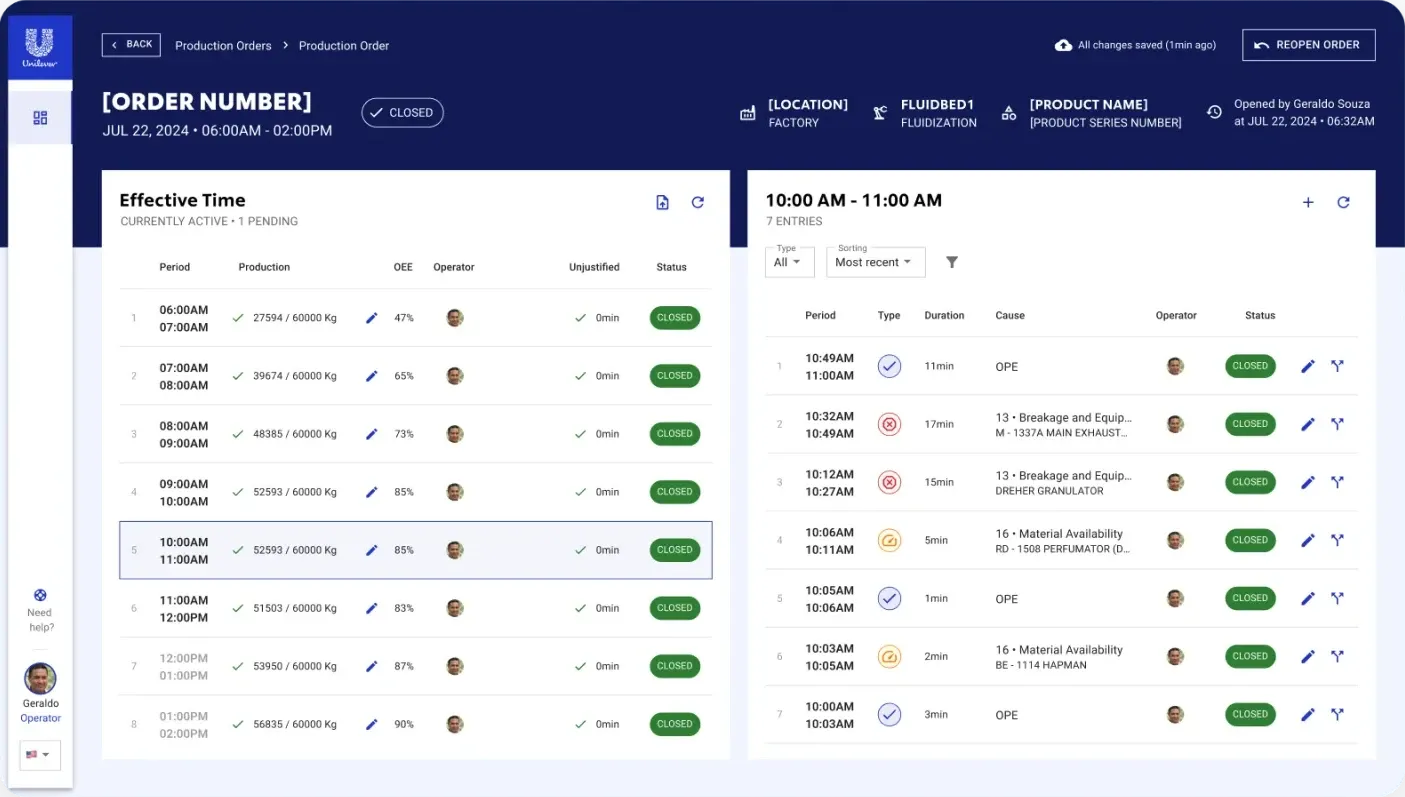
One dashboard
Several screens and workflows brought into a single, practical dashboard.
A clearer ticket system
The ticketing system rebuilt for clarity.
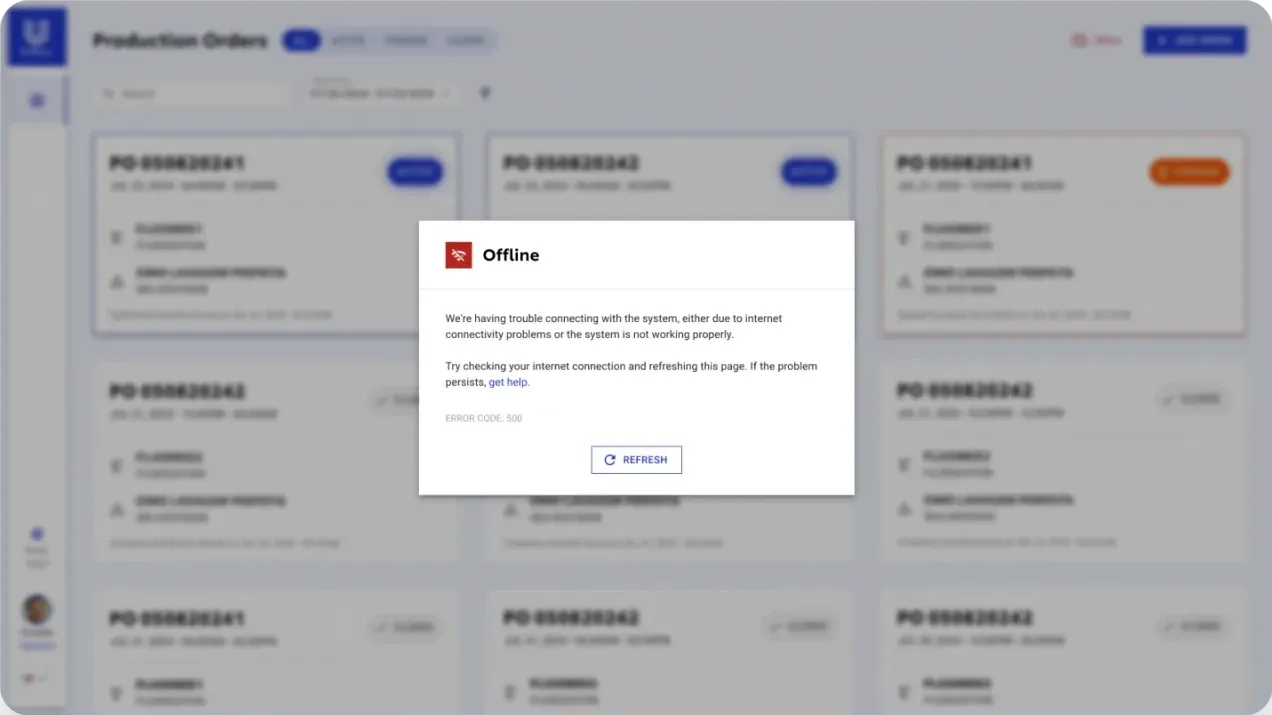
Reliable data handling
Automatic saving that alerts users to connectivity issues, prevents data loss during server problems and keeps the data accurate.
Simpler UX overall
Straightforward forms, progress kept when errors happen, and a clear, logical interface.
Deliverables
The implementation plan is a flexible roadmap that handles risks and requirements through phased deliveries, so operators adopt the system step by step and it fits the systems already in place.
It also looks past the first deployment: rolling out across factories and regions, with new integrations, safety protocols and automation features planned, all aimed at a better return on the investment through smoother operations, fewer human errors and a more dependable system.
We delivered:
- the workshop material, conclusions and personas;
- a prototype of the primary persona’s journeys;
- a tech assessment to take development forward;
- a roadmap that weighs effort, risk, team setup and priority, and leaves room for later decisions.

We initially had no idea how valuable the Discovery stage would be for our project. Vinta didn’t just address our requests; they also proposed tangible improvements that were practical and easy to implement.

As the next step, Unilever planned a dedicated team of developers, designers and a project manager to start the implementation, with the roadmap refined after the kickoff as new requirements came up.