6months together
- Backlog triage30 pages into ranked tickets
- Rebuild and launch80+ tasks, live in 3 months
What we did
- Tech Debt & LegacyRewrote most of a half-built frontend and fixed the security flaws a previous vendor left.
- Full-Cycle DevelopmentTook a half-built Django and React product to a launched MVP in three months.
- Modern JavaScript DevelopmentOne scheduling screen for availability, bookings, cancellations and refunds, in Redux.
- Django DevelopmentLedger-like payments and refunds, and monthly Stripe invoices sent on each listing's timezone.
Built with
- Django
- React
- Digital Ocean
- Python


Qikbook started as a marketplace where building owners and managers rent out counseling rooms to therapists, and is now a booking app for coworking spaces. Its founder, Chris Sharp, came to Vinta after a first consultancy left him with a half-built Django and React product, low-quality code and security flaws. We turned his 30-page backlog into ranked tickets, rewrote most of the frontend, fixed what was broken, and launched the MVP in three months.
3 months
from a half-built product to an MVP in real users’ hands.
80+ tasks
done along the way: bugs, improvements and new features.
About Qikbook
Counseling rooms are where counselors and therapists hold their sessions, set up to be comfortable and confidential so people can talk about their concerns, emotions and experiences.
The building owners and managers who run these rooms often oversee several of them, and had no automated way to manage them. Most of the tools they could find were generic scheduling apps, not made for this sector’s needs.
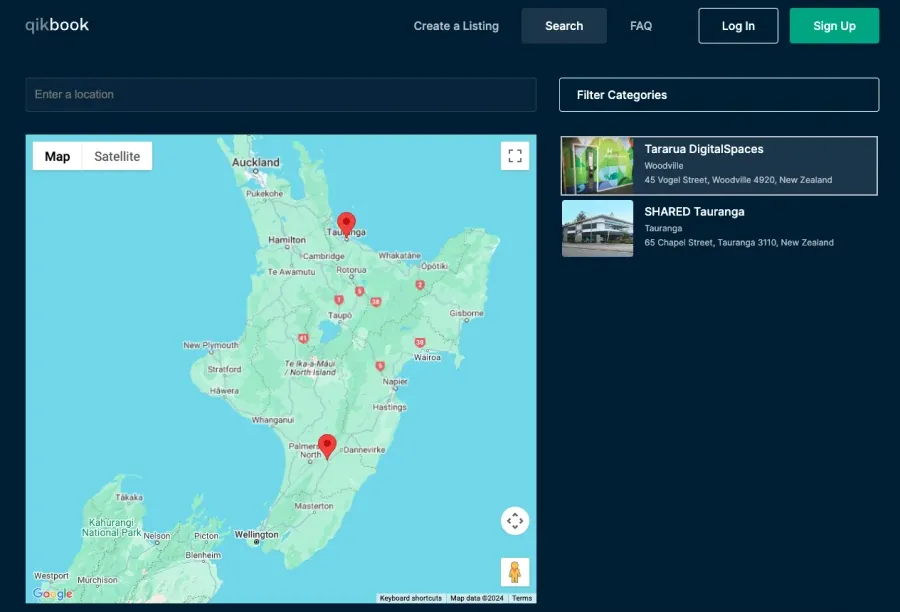
Qikbook launched as a marketplace for booking and managing these spaces. Unlike its competitors, it did not charge a subscription fee: it took a small commission on the bookings made through the platform. Its listings showed each building and its rooms, so users could explore their options before they signed up.
Qikbook has since grown beyond counseling rooms. Today it is a booking app for coworking spaces in Australia and New Zealand: operators list their meeting rooms and hot desks, and their members book and cancel them in a few clicks, for a flat monthly fee with unlimited locations, spaces and users.

The challenge: starting over on a half-built product
Chris is a former building owner and manager. Before Qikbook, he tried several apps, and none of them was right for managing counseling rooms.
He first hired another consultancy to build his idea with him. Chris tried to explain what he needed, but language barriers got in the way from day one.
Communication was not the only problem. The backend code was somewhat acceptable, but the frontend was of such poor quality that most of it had to be rewritten, and some components were far too complicated to manage:
80%
of the frontend code needed a complete rewrite.
55 states
in a single frontend component.
The consultancy had also assigned a DevOps professional to set up deployment and the production environment, once. They used virtual machines, which are less efficient and harder to maintain than more modern options such as containers, and the choice added complexity and limits to the project.
In the end, the consultancy could not deliver what Chris wanted, and he would need to start over. That is when he came to Vinta.
Our approach: from a 30-page document to a ranked backlog
Chris arrived with a half-built Django and React product and a backlog document of almost 30 pages of bugs and improvements. We knew from the start it would be hard: much of the codebase was low quality, which left us very few references to work from.
Before writing code, we turned that document into a structured list of tickets. It read like an essay, with nothing filtered out, so we kept each ticket linked to the part of the document it came from. We imported the tasks into Asana, grouped them by the application’s modules, and ranked them by priority and complexity.

Then we went through every ticket with Chris in a long meeting, to check that the list reflected what he needed and that our priorities matched his. With an ordered backlog, conversations about where to focus became simpler, and the development team could work without having to find its way through the original document.
Working together from 16 hours away
Working with a CEO who has a clear vision for the business makes decisions faster. We kept Chris close with daily async reports and weekly meetings, and used the time together for product demos, feedback and aligning requirements, despite the 16-hour time difference to New Zealand.
Our time zone usually suits international clients, and as a remote-first company we are used to working asynchronously, with instant messaging when we cannot meet face to face. At Vinta, engineering and management work closely together, so we spot potential problems early and raise them as soon as we see them.
As the MVP took shape, Chris found features beyond the original scope that he felt were worth the extra time and money. As these requirements piled up, time became an issue. Our project manager gave him two options: reduce the scope and simplify, or extend the contract to cover everything. He chose to extend, and said every investment in our team had been worthwhile.
The product: one place to run the rooms
The MVP let building owners and managers run their listings and control how they run their business, down to the details:
Cancellation policies
Set the cancellation rules that suit each business.
Delegated managers
Choose other users to manage their listings for them.
VIP users
Set special conditions for VIP users.
Booking for users
Book and cancel rooms on behalf of their users.
Public or private listings
Keep listings public, or private to their own clientele.
The scheduling experience covers all of this, and it was the hardest part to build: it took extensive use of Redux and modern JavaScript to keep it fast.
How we built it: the tech behind the MVP
Scheduling on a single screen
The first challenge was Qikbook’s all-in-one scheduling. A single screen handles the availability of listings and rooms, restricted dates, existing bookings, cancellation rules, permissions, and what is due in payments and refunds. Modern Redux tooling (Slices, Selectors and Immer) kept the frontend fast and its complexity organized.
Payments and refunds, kept like a ledger
We wrote the payment and refund calculations from scratch, in a ledger-like way that keeps the refund logic simple. The booking logic ended with test coverage close to 100%, so it could be trusted to be correct.
Bookings in every time zone
For the platform to work anywhere in the world, the booking flow supports every time zone. Integrations find each listing’s time zone from its address, and the database, the business logic and the frontend all use it correctly.
Monthly commission invoices on Stripe
At launch, Qikbook collected its commission automatically, through a monthly Stripe invoice. On the first day of each month, in each listing’s time zone, the system calculated the commission due on the previous month’s bookings.
Huey async tasks schedule and run this job; we extended Huey’s crontab to make it time-zone-aware. The invoices were created in the system and sent to Stripe Invoices, and when a client paid through Stripe, webhooks updated the system automatically.
Fixing the security flaws
The code we inherited also had security issues: validation done only in the frontend, and incorrectly; permissions implemented wrongly in the backend; and JWT expiration and refresh tokens used inaccurately, among many others.
We fixed and reimplemented all of it, which made code review central to paying down the technical debt. We tested the existing code, and rewrote it where that was necessary and strategic.
Open-source tools
As usual, we built on existing open-source tools to deliver key features faster:
dj-rest-auth
Helped us reimplement login, passwords, log-out and the JWT logic.
Mantine Table
Helped us reimplement the Booking & Logs listing and filtering pages.
django-safedelete
Sped up soft deletion, so admins can restore data easily.
A custom Django Admin
With several actions that make admins’ lives easier.
Product consultancy: a bootstrapped launch
As a marketplace, Qikbook would face many challenges, but choosing which side to grow first, supply or demand, was not one of them. Many building owners already had their own customers, so every new listing brought its demand with it. Chris knew this strategy would get him where he wanted.
He was just as clear on how to validate the idea: knock on doors and offer Qikbook to the hundreds of building managers who were in the situation he had been in years before.
Qikbook was intentionally bootstrapped. Chris was not after investment at first: he wanted to validate the MVP and take the revenue route from the start, as more self-funded ventures do now that investment is harder to come by. With his vision clear, we made sure every feature followed the product’s philosophy: simple yet powerful features, and, at launch, no subscription fee.
When a product needs more discovery, our product consultancy explores strategy, validation methods, research and metrics with you.
Outcome: an MVP launched in three months
By the end of our cycle with Qikbook, we had completed over 80 tasks: bugs, improvements and new features. Chris launched the system in three months and put it in real users’ hands. Qikbook has kept growing since, from counseling rooms to coworking spaces.


Vinta’s work is exemplary. At the end of the day, it’s about the quality of work.