3months together
- Renter dashboardA 0 to 1 launch, on schedule
- Pricing and add-onsLRO and the biggest client win
- Platform healthPoetry and faster screens
What we did
- Dedicated TeamThree senior developers and a project manager working inside the startup's team.
- Modern JavaScript DevelopmentRebuilt the renter dashboard from the design team's mockups, matching them exactly.
- Web DevelopmentLease revenue optimization, a flexible add-on system and the security deposit alternative.
- Tech Debt & LegacyMoved dependencies to Poetry and fixed the queries and requests slowing large screens.
A US proptech startup that connects property management companies with renters was ready to launch its first consumer product, a renter dashboard under a new brand, but its three-person engineering team could not keep pace with its design team. Vinta joined with three senior developers and a project manager: the dashboard launched on schedule, and the pricing and add-on features we built helped the startup win its biggest client to date.
About the startup
The startup runs a property management platform in the US. It connects property management companies with renters through online applications, screening and financial products, and it integrates with the Property Management Systems (PMS) property managers already use, so they can adopt it without changing tools.
Beyond its core application management, it offers three specialized services:
Decision assistance
Automated help for property managers deciding on applications.
Pet verification
A workflow to check and approve renters’ pets.
Deposit alternatives
Monthly payments in place of a traditional security deposit.
The challenge: a consumer launch with a three-person team
With its B2B platform established, the startup was ready for its most ambitious project: a renter dashboard for consumers, opening a marketplace of renter services under a new brand. It was a zero-to-one launch into a market where it had to compete with established players and build its brand from scratch, and missing the launch window could cost it the first-mover advantage.

The MVP date was close. The design team had already finished the mockups and user flows, but the three-person engineering team could not turn them into production code fast enough. A delay risked the startup’s competitive position, the revenue of the new consumer segment, and leaving the gap it meant to fill to a competitor. A successful launch, on the other hand, would diversify its revenue and make it a complete rental solution.
The stack
The startup used a different tool for each product area: React, Gatsby and Remix on the front end, Django, Temporal and AWS behind them.

React
Across several specialized applications, with the older Create React App one planned for retirement.

Gatsby
For specialized workflows.

Remix
For the newer application interfaces.

Django and Python
The API services, over HTTP/REST and following OpenAPI 3.

Temporal
Orchestrating the complex workflows.

AWS
The cloud infrastructure.
Our approach: part of the startup’s team
When the startup’s former CTO reached out, they knew what they needed: experienced full-stack developers who could take detailed designs and build them quickly without lowering quality. Not consultants to rethink the approach, but developers to do the work inside the existing team.
We joined as a dedicated team of three senior developers and a project manager, all experienced in the startup’s stack, which let us work on several product areas at once. We worked closely with the design team, and the goal was not a minimal version: each screen had to match the design exactly, because consumers expect more from an interface than B2B users do.
What we built

The renter dashboard
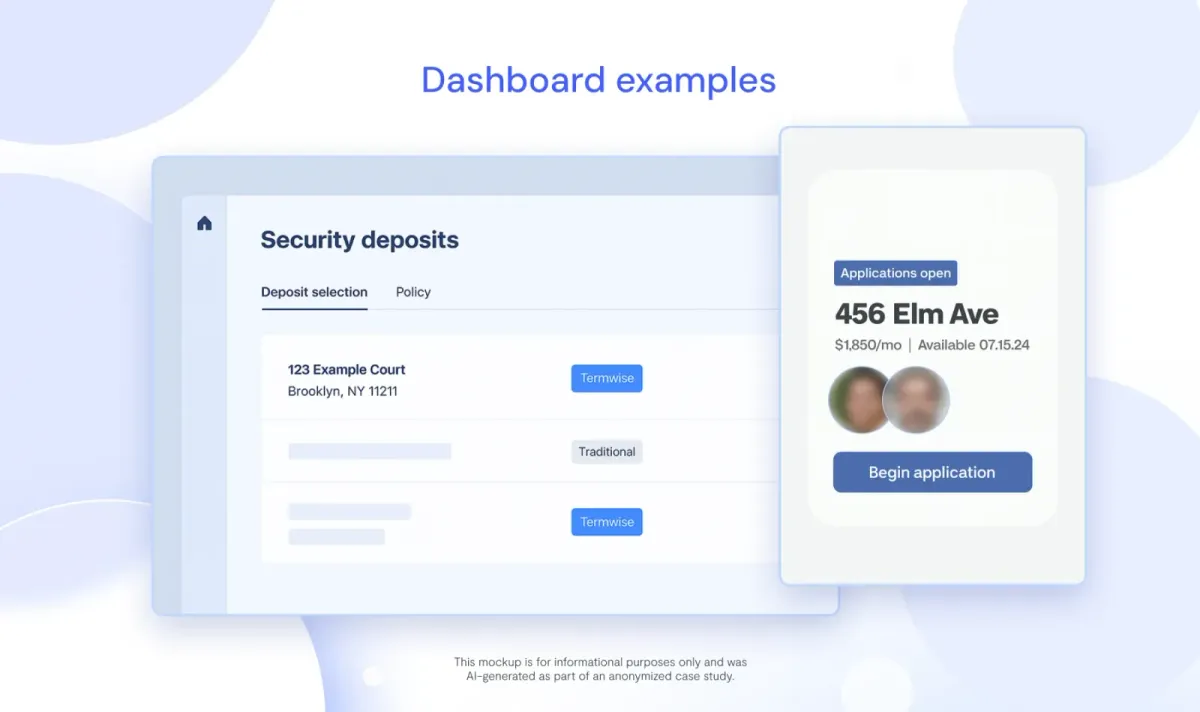
We rebuilt the startup’s consumer application from the ground up, since the previous version could not support the features and experience the company had planned. We built it with modern JavaScript from the design team’s mockups and reviewed every interaction, transition and visual detail with that team, because the dashboard would be where renters first met the platform’s services.
The new dashboard brings together application management, document uploads and communication tools, making renting simpler for renters and property managers alike.
Lease Revenue Optimization (LRO)
We implemented the startup’s Lease Revenue Optimization (LRO) system, which lets property managers vary rent with lease length and market conditions. They set their pricing strategies in a simple interface, and the system runs the calculations behind each recommendation. It became essential for winning enterprise clients, who need advanced revenue management across their portfolios.
A flexible add-on system
Property management companies offer different amenities and services in each property. We built a generic add-on system for parking spaces, storage units and premium amenities, with templates property managers configure themselves, without technical help. It works across property types with the same experience for renters, which let the startup serve a wider range of clients.
Security deposit alternative
Security deposits can keep renters from securing a home. We implemented the startup’s alternative, which works with third-party insurance providers to offer monthly payments instead. It depends on external APIs, so we built robust error handling, plus tracking and reporting that keep both renters and property managers informed. The feature set the startup apart from traditional property management solutions.
Pet verification workflow
The pet verification service moved from manual work to a partly automated workflow. We built state tracking for each step, so property managers see exactly where each request stands and pet owners get status updates along the way. Requests are evaluated faster and with less manual work, so the platform can take on more of them without the evaluation team growing as fast.
Platform health: Poetry and faster screens
Alongside the features, we paid down technical debt that slowed both the team and the platform.
Dependencies managed with Poetry
The project managed its Python dependencies with pip and requirements.txt files. Versions conflicted often, each developer’s environment differed, and deploys behaved unpredictably; developers spent hours on environment issues instead of features.
We moved the whole project to Poetry, whose lock file gives every developer and every environment the same package versions, ending the “works on my machine” problem. We planned the migration so it would not disrupt ongoing work, and the results showed right away: development cycles became more predictable, and the team could build several features in parallel as it grew.
Faster screens
Screens showing large amounts of data took up to 30 seconds to load, or timed out in production. We audited their performance and fixed three kinds of problems:
Database queries
N+1 queries and other inefficiencies that made response times climb as the data grew.
Front-end requests
Screens making needless API requests, from React lifecycle mistakes or repeated data fetching.
Listing screens
Busy listings of hundreds of items, investigated one by one and made much faster.
Some larger architectural changes we proposed were set aside over stability concerns, but the optimizations that shipped made the screens measurably faster, which matters for keeping users on the platform.

Quality: no critical bugs in production
Every feature we built reached production without critical bugs or downtime. Four practices made that possible:
Reviews and pairing
Thorough code reviews and pair programming sessions.
Automated tests
Tests that caught issues before deployment.
Staged rollouts
Releases rolled out in stages, to keep the risk low.
Working with QA
Close collaboration with the startup’s own QA process.
For a company entering the consumer market, that reliability helped it earn renters’ trust.
Outcome: an on-time launch and the biggest client
On-time launch
The renter dashboard launched on schedule and without significant issues, taking the startup into the consumer market.
Biggest client win
The add-on system and LRO set the startup apart and helped it win its largest client to date.
A sounder foundation
The move to Poetry keeps paying off in the team’s productivity and the platform’s maintainability.
A faster team
With the technical debt paid down, the startup’s own developers could work faster.
With experienced developers working inside its team and process, the startup took its market opportunity without lowering its quality bar: designs built exactly as drawn, and improvements that last beyond the launch.