Dr. Helen Ward
 Claire Brooks
 Grace Chen
 Rosa Diaz
 Sam Patel
 June Ross
 Walter Kim
4months together
- Product Discovery2 weeks
- Building the MVPProvider portal on Medplum
What we did
- Product DiscoveryTwo weeks to a validated prototype of the provider portal and a streamlined MVP scope.
- Medplum DevelopmentA technical assessment of how Medplum’s components and FHIR resources fit their custom EHR.
- UI/UX DesignFigma mockups of the provider portal, from the patient dashboard to care plan tools.
- Healthcare Integration & InteroperabilityPlanned the links to Awell care flows, Cal.com scheduling and the family app.
- Dedicated TeamTwo developers and a fractional manager who moved on to building the MVP.
A specialty care startup for children was two months from launch and needed a custom EHR for the providers who treat its families. Vinta ran a two-week Product Discovery on Medplum: the startup got a validated prototype of its provider portal and a lean MVP scope, and our team moved straight into building the MVP.
2 weeks
from kickoff to a validated prototype of the provider portal and a lean MVP scope.
2 months
until the provider portal’s launch when the startup reached out to Vinta.
About the company
The company is a specialty care platform for children. It offers personalized evaluations and holistic therapy, and takes a family-centered approach: it connects families with services and with communities facing the same challenge, treating the child as a whole rather than a single condition.
30+ years
of research behind the company’s evaluations and therapy for children.
It runs two applications: an mHealth app for patients’ families and a web platform for the specialty care providers who treat them. The company asked Vinta to design a custom EHR for those providers and, through them, the families.

The challenge: choosing the right EHR foundation
Most healthcare clinics know that building a compliant, interoperable solution from scratch is hard:
50%+
of EHR systems fail or are never properly used.
70%
of healthcare technology projects fail, counting delays, cost overruns and missed goals.
To avoid these costly failures, healthcare organizations increasingly look for tools that speed up product development while meeting the industry’s requirements. But how do you build on a standard and still customize the features that make your product valuable?
This company’s answer was Medplum, an open-source platform for building healthcare applications. Medplum is built on FHIR (Fast Healthcare Interoperability Resources) and provides ready-made building blocks for medical charting, which shortens early development. The company chose Vinta for our standing as a top-tier Medplum consultancy and on a recommendation from Medplum’s CEO.
Our team had already built several Medplum-powered solutions, so we knew it was the right foundation for the client’s portal. Starting on Medplum saves development time and, with it, money for founders: the platform provides ready-to-use components, bots and serverless functions that the team can customize.
The family app was outside the MVP’s scope, but the Product Discovery still had to plan how the two apps would integrate. Our team had to keep synchronization points to a minimum so that a two-way integration would work later, since data had to flow from a family’s sign-up in the mobile app all the way to claim payment on a Revenue Cycle Management platform.
The core challenge was identifying the features specialty care providers needed to care for patients through the web portal. Every patient interaction would be documented in the custom EHR, so practitioners would depend on how fast and easy it was to use. Our goal was to turn a time-consuming administrative process into a simple workflow, giving providers more time for what mattered most: caring for families.
Connecting Medplum and Awell
Another challenge was integrating Medplum with Awell Health, the care flow platform the company chose for its providers. Awell lets teams design and automate care flows, so practitioners spend less time on daily operations.
With Awell, teams build their own clinical pathways, automate patient communications and manage assessments. The platform takes over repetitive tasks, from patient outreach and follow-ups to clinical questionnaires and care plan updates.
We worked with the client and Awell Health to map how the two systems would connect, focusing on automating clinical workflows. Those sessions gave us a clear strategy for the integration. Read more about how Awell and Medplum work together.
Our approach: a two-week Product Discovery
To address these challenges, we put together a team for the client’s Product Discovery: an experienced project manager, a senior designer and an engineer, bringing the different perspectives healthcare development needs. Through interviews, workshops and technical assessments, we laid the groundwork for a thorough implementation plan.
This helped us map immediate solutions, align on a vision with stakeholders and understand practitioners’ needs before any hands-on development.
With the provider portal’s launch only months away, we kicked off the Product Discovery with an MVP launch alignment session that brought together the company’s stakeholders and our team. This first step helped us set precise goals and spot roadblocks early, so the development plan would meet both the timeline and the high quality healthcare applications demand.
With the whole solution in view, we focused on the practitioners who would use the platform every day. As power users managing critical patient data, they needed every medical record workflow to be well documented and easy to reach.
We analyzed practitioners’ technical proficiency and workflow needs and validated our findings with the company’s Chief Clinical Officer. That understanding was the basis for the detailed user journey maps that guided development.
Designing the EHR around practitioners
The provider portal and the family app had to share data without friction while each kept a clear purpose of its own. Our team mapped the whole ecosystem, tracing how patient information would move between families and clinicians without duplication.
From that analysis, we built a map of every interaction between practitioners and families, documenting each point where data enters the EHR. The aim was to turn manual processes into automated workflows, freeing practitioners to focus on patient care.
With the user journeys from the Product Discovery in hand, we turned clinical workflows into clear interfaces in Figma mockups, covering the practitioner’s whole experience, from the patient dashboard to the care plan tools. Medplum’s React component library, built on Mantine, let us move faster without lowering quality.
Building on proven design systems such as Mantine and MUI is central to how we build EHRs: we don’t reinvent the wheel. Combining proven components with custom features, we deliver faster and more cost-effectively, with interfaces practitioners can learn quickly and rely on.
The technical assessment: derisking development
A key outcome of the Product Discovery was a Technical Assessment that reduced development risk. After validating Medplum’s components, the FHIR resources and the system’s feasibility, our engineers wrote a roadmap that balanced Medplum’s pre-built components against the company’s custom EHR requirements, giving a clear path to implementation with every critical feature accounted for.
For the company, this became an actionable development document, from FHIR resource specifications to Medplum strategies and a map of every system integration. Here’s how each part speeds up secure development:
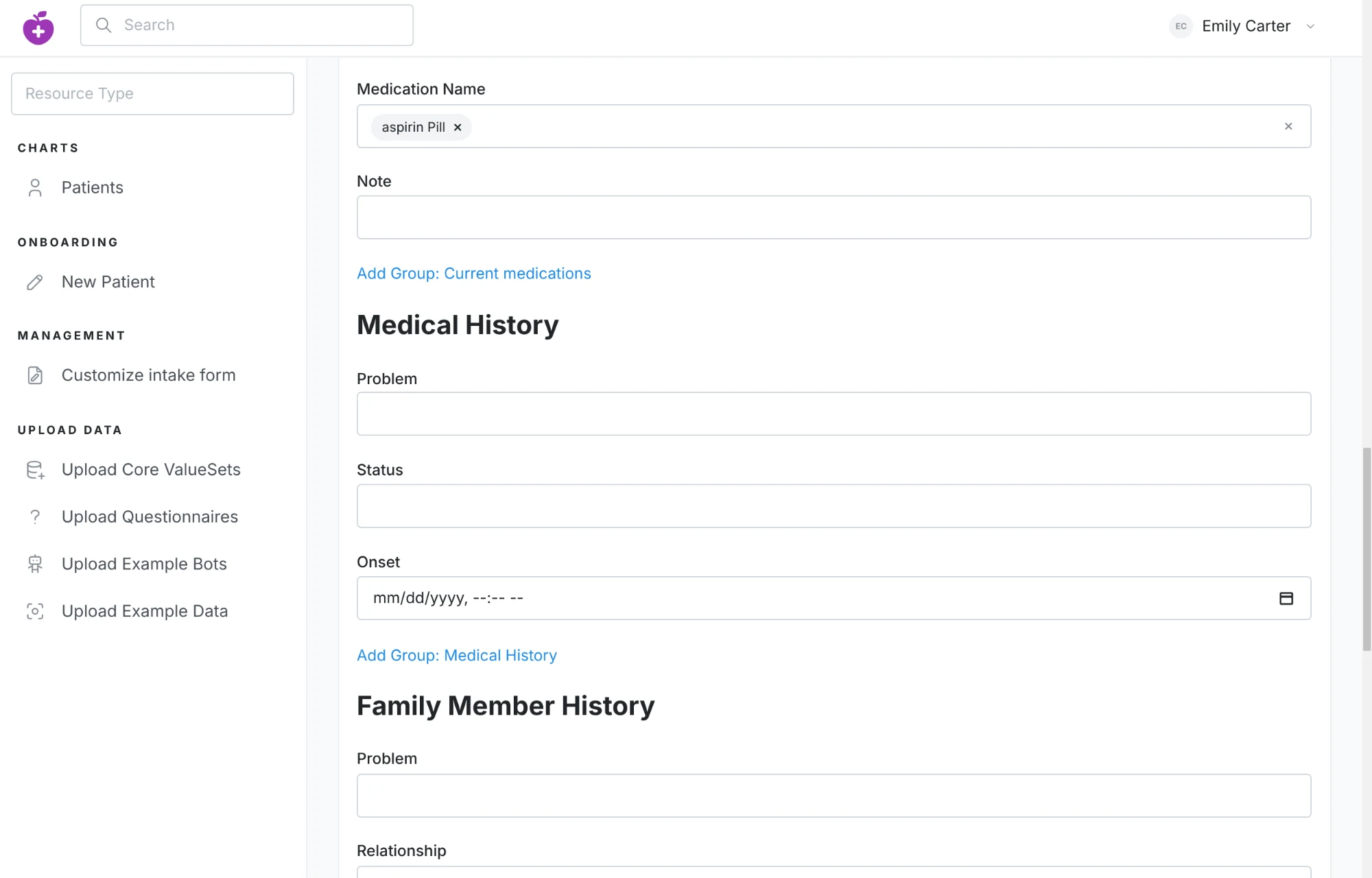
Medplum Admin
Medplum Admin is a web application for administering projects, managing users and setting up access policies and groups. It’s ready to use, so using it instead of building a custom admin saved development time.
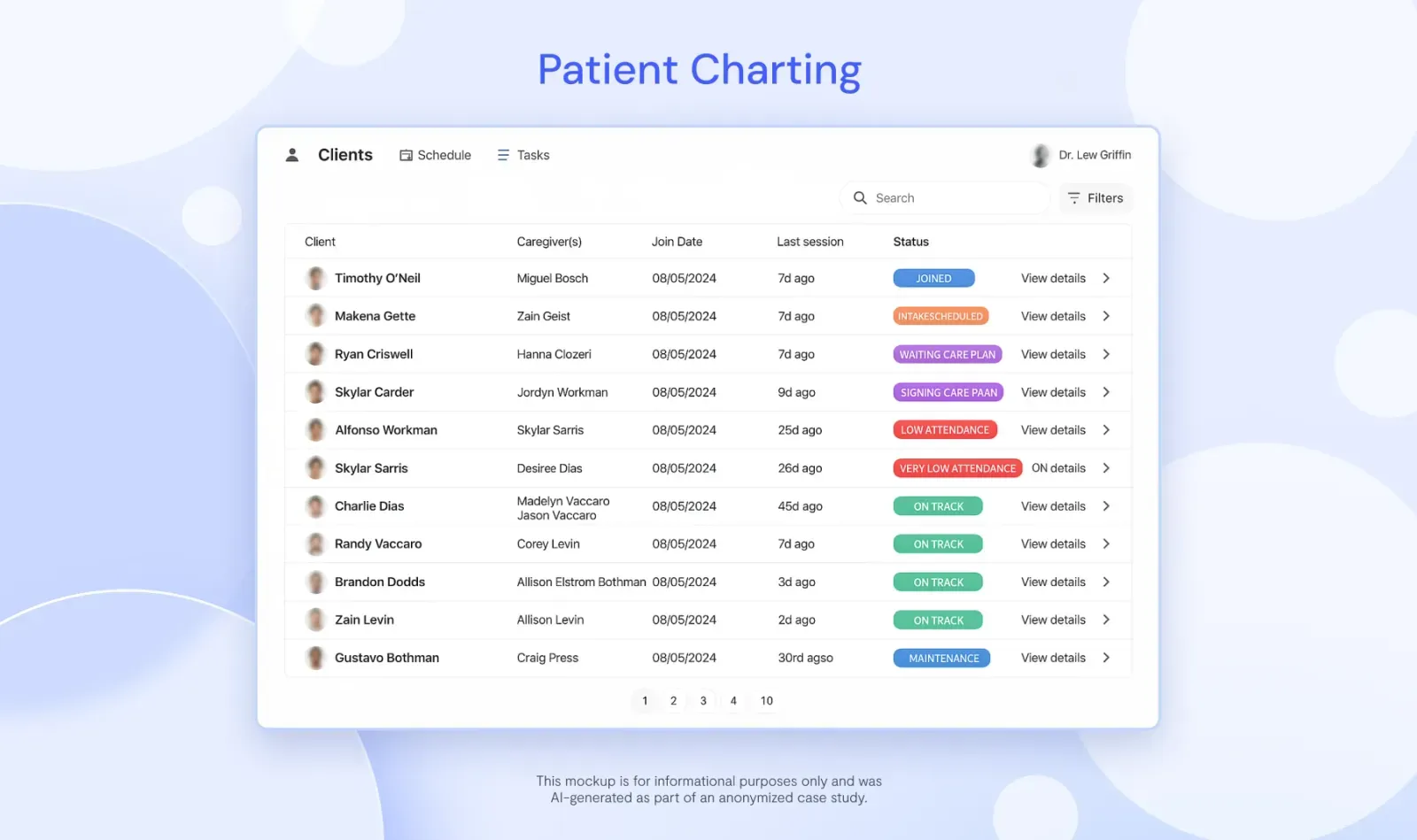
Patient charting
Building on Medplum’s sample patient charting flow, we designed an expanded patient charting system that helps practitioners manage patient data efficiently. It adds an interface tailored to clinicians’ needs, with timelines, detailed care plans, group management and structured encounter documentation, while keeping the Medplum integration and FHIR compliance for healthcare data exchange.
Medplum’s pre-built components speed up development, but FHIR’s structure set limits we had to design around. The standard restricts certain data operations, such as filtering by status or join date, so our design team found workarounds that stayed compliant and kept the interface easy to use.
Scheduling and tasks
Medplum supports clinical operations with built-in features such as task management and scheduling. Its customizable sample projects offer a foundation that can be tailored to specific healthcare workflows, so organizations can put these operational tools in place quickly.
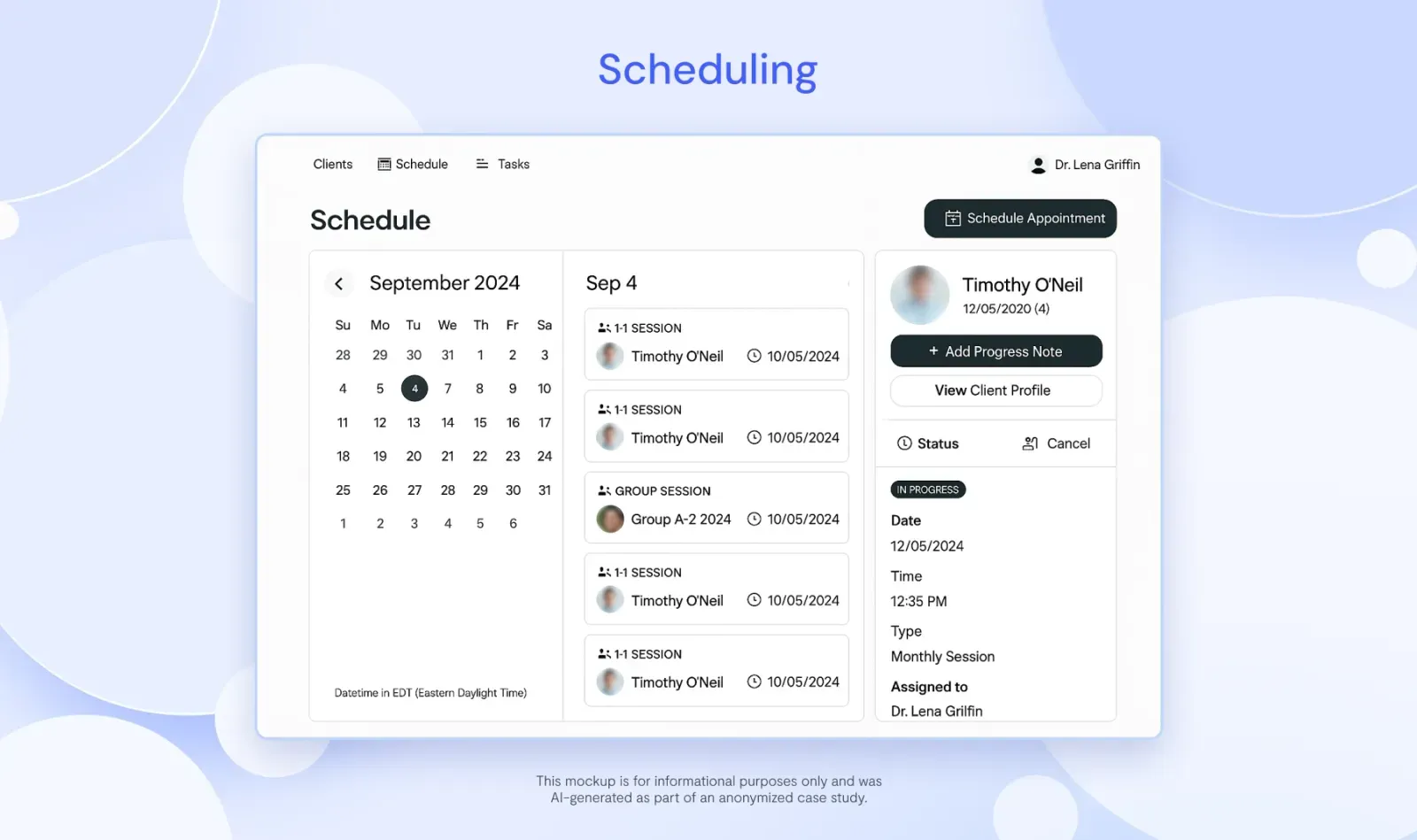
For scheduling, we integrated Cal.com, a platform for booking meetings and managing notes. The integration runs on webhooks, which notify the EHR when something happens in Cal.com: here, when an invitee schedules, cancels or reschedules a session, or when a meeting ends. Learn more in Cal.com’s webhook guide.
Outcome: a validated prototype in two weeks
In two weeks, the Product Discovery gave the client:
Product strategy validation
The product’s direction assessed and confirmed, aligned with provider needs and user personas through stakeholder interviews.
User journey mapping
The portal’s navigation mapped around every step of a practitioner’s day, from patient intake to care plan management.
Journey visualization
High-fidelity mockups of the interfaces for clinical documentation and patient management.
Roadmap
The MVP’s delivery planned in clear phases, balancing a fast launch against a complete feature set.

I love the tangibility that Vinta brought to our provider portal. What they put together in 2 weeks is impressive.

Our design put clinicians first, simplifying their workflow so they could focus on their patients. From that foundation, we moved into development with a dedicated team (two developers and a fractional manager) working in short, iterative delivery cycles. Learn more about how we take healthcare MVPs to market.