3months together
- Care flow workshopsPathways, roles and journeys
- FHIR mappingEvery entity to its resource
- Medplum architectureAnd a plan ready to build on
What we did
- Healthcare DiscoveryWorkshops on Perci's care flows, practitioner roles and patient journeys before any build.
- Healthcare Integration & InteroperabilityMapped Perci's care model to FHIR and set how Awell and Medplum share data.
- Medplum DevelopmentValidated Medplum's fit and designed Perci's Medplum architecture and rollout plan.
Digital cancer care has many moving parts: changing patient needs, multidisciplinary teams, structured clinical programs, and sensitive documentation that must be captured the same way every time. A platform for it needs an EHR foundation that expresses clinical reality instead of bending it.
Perci Health is building a virtual-first approach to survivorship and cancer support, delivered through expert-led programs and orchestrated clinical workflows. As its product and operations matured, Perci needed to move its system onto a secure, interoperable foundation that could support clinical precision and long-term scale.
It asked Vinta to validate Medplum’s fit and to translate its care model into a clean FHIR architecture, ready to build.
The challenge: putting a care model into FHIR
Perci’s product already served patients with multidisciplinary clinical support, routed through Awell’s workflow engine and run by a growing engineering team. Adopting Medplum meant deciding how encounters, practitioner roles, clinical reasoning and billing-related logic should be represented in FHIR.
Its questions were the ones many fast-growing healthtech teams face:
- How should existing workflows map into FHIR, and where should data live?
- Where do encounters begin and end in a virtual-first model?
- How should practitioner roles, teams and program eligibility be structured?
- Which entities belong in Medplum, and which stay under Awell’s orchestration?
- How do we remove ambiguity now, so implementation stays safe later?
Our approach: three months, four steps
Over three months, we worked closely with Perci’s engineering team to give the system structure and a plan that would hold as it grew. The work followed Vinta’s Healthcare Consultancy approach: collaborative, led by the architecture, and grounded in how clinical care actually happens.
1. Understanding the care flows
We started with workshops on Perci’s Awell pathways, expert roles, program entitlements and patient journeys over time. That context shaped every FHIR decision after it.
We aligned on:
- the clinical touchpoints and what each needs documented;
- the boundaries between practitioner and specialist roles;
- what an encounter is in a virtual, multidisciplinary model;
- how data should move between Perci’s apps, Awell and Medplum.
These first sessions removed ambiguity and gave both teams the same picture of the system.
2. Mapping Perci’s model into FHIR
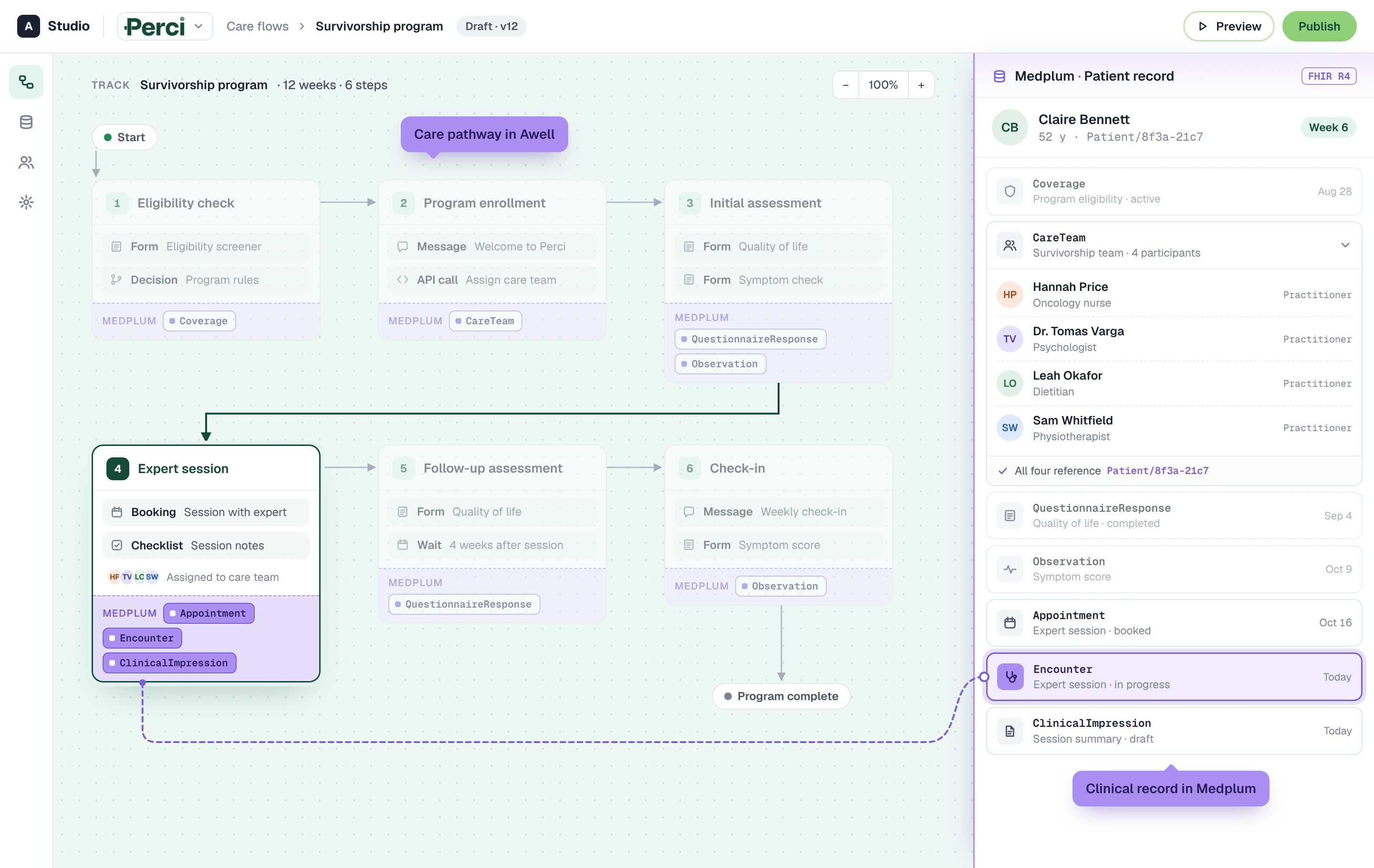
Next, we matched each concept to the right FHIR resource, paying close attention to relationships and constraints. The mapping covered Patient, Practitioner, PractitionerRole, CareTeam, Appointment, Encounter, Observation, ClinicalImpression, QuestionnaireResponse, DocumentReference, Coverage, ChargeItemDefinition, Account and more.
We set out where standard profiles fit, where extensions were needed, and how Perci should handle provenance, versioning and permissions. The result was one consistent mapping that the engineering and clinical leads could trust.
3. Designing the Medplum architecture
With the model defined, we designed Perci’s architecture on Medplum. The blueprint covered:
- the lifecycles of encounters, sessions and assessments;
- how Awell works with Medplum without the two duplicating responsibilities;
- which data the orchestration owns and which the EHR owns;
- safe patterns for storing clinical documents and role-sensitive information.
We designed how the system should behave, not just how it should store data.
4. Delivering a plan ready to build
It all came together in a detailed implementation blueprint:
- resource schemas and mapping tables;
- what Awell and Medplum are each responsible for;
- risks to watch and compliance considerations;
- a phased plan for a safe rollout, testing and clinician onboarding.
By the end, Perci had a validated architecture and a reference model its team could apply right away.
What Perci took away
A complete FHIR model
Perci’s multidisciplinary programs, clinical assessments and episodic workflows, translated into a clean, normalized FHIR structure.
An architecture that fits the practice
A Medplum blueprint where encounters, documentation, team roles and patient relationships behave the same way across care flows.
Integration guidance
How Awell should read, write and keep information in sync with Medplum.
A roadmap that lowers risk
A validated plan that heads off misalignment, rework and clinical inconsistencies before implementation, not halfway through it.
Outcome: ready to build
Perci finished the consultancy ready to move forward. Its engineers now know what belongs in Medplum, how the clinical entities relate to each other, and what the EHR must express to support safe, consistent care.
With that clarity, the team can move faster in the next engineering phase, with less ambiguity, on a platform grounded in clinical accuracy.