Today I learned
Fun Vim shortcut of the day: map <F7> :!pytest %<CR> "Run pytest for the current file on buffer
Gustavo Carvalho

The links, tools and tips our engineers and designers share with each other, one “today I learned” at a time.








Today I learned
map <F7> :!pytest %<CR> "Run pytest for the current file on bufferGustavo Carvalho
Tech Insights
map <F7> :!pytest %<CR> "Run pytest for the current file on bufferShared by

astronomer.io
Get to know the best ways to dynamically generate DAGs in Apache Airflow. Use examples to generate DAGs using single- and multiple-file methods.
Flávio Juvenal
Tech Insights· astronomer.io
From astronomer.io
Get to know the best ways to dynamically generate DAGs in Apache Airflow. Use examples to generate DAGs using single- and multiple-file methods.
Shared by
Tech Insights· stackoverflow.com
Shared by
docs.python.org
pdb.pm() puts a breakpoint at the traceback found in sys.last_traceback . This is really useful when you're running some ...pdb.pm() puts a breakpoint at the traceback found in sys.last_traceback . This is really useful when you're running some method in a console and you need a breakpoint at the moment the code threw the exception. See more at: #pdb.pm
Carlos Coelho
Tech Insights· docs.python.org
pdb.pm() puts a breakpoint at the traceback found in sys.last_traceback . This is really useful when you're running some ...pdb.pm() puts a breakpoint at the traceback found in sys.last_traceback . This is really useful when you're running some method in a console and you need a breakpoint at the moment the code threw the exception. See more at: #pdb.pm
Shared by
Tech Insights
side_effect instead of return_value like this: mock_func.side_effect = [return_value1, return_value2]Shared by
Tech Insights· medium.com
Shared by
Tech Insights· matthewrocklin.com
Shared by
Tech Insights· stackoverflow.com
Shared by
Tech Insights· heartbeat.fritz.ai
Shared by
pythonspeed.com
Alpine Linux is often recommended as a smaller, faster Docker base image. But if you’re using Python, it will slow down your build and make your image larger.
Gustavo Carvalho
Tech Insights· pythonspeed.com
From pythonspeed.com
Alpine Linux is often recommended as a smaller, faster Docker base image. But if you’re using Python, it will slow down your build and make your image larger.
Shared by


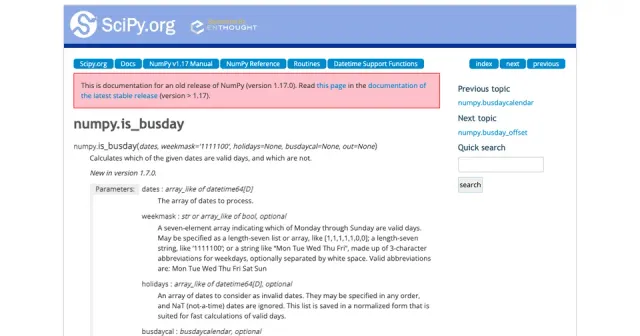
docs.scipy.org
is_busday to check whether a given date is business day or not, it also can receiv...numpy has a really handy function called is_busday to check whether a given date is business day or not, it also can receive a list of parameters to give this functionality a power boost such as weekmask (if you need a custom definition for weekdays) and holiday calendar
Carlos Coelho
Tech Insights· docs.scipy.org
is_busday to check whether a given date is business day or not, it also can receiv...numpy has a really handy function called is_busday to check whether a given date is business day or not, it also can receive a list of parameters to give this functionality a power boost such as weekmask (if you need a custom definition for weekdays) and holiday calendar
Shared by
Today I learned
datetime.datetime.combine can d...You don't need a hacky snippet to manipulate dates into the a specific moment, such as EOD. datetime.datetime.combine can do that for you as it receives three parameters: date (can be datetime too), time and tzinfo , the latter being an optional argument. The following snippet will put a given date into EOD: ``` from datetime import datetime, time date = datetime.strptime("2019-01-01", "%Y-%m-%d") # datetime.datetime(2029, 1, 1, 0, 0) eod_date = datetime.combine(date, time.max) # datetime.datetime(2029, 1, 1, 23, 59, 59, 999999) ```
Carlos Coelho
Tech Insights
datetime.datetime.combine can d...You don't need a hacky snippet to manipulate dates into the a specific moment, such as EOD. datetime.datetime.combine can do that for you as it receives three parameters: date (can be datetime too), time and tzinfo , the latter being an optional argument. The following snippet will put a given date into EOD:
``` from datetime import datetime, time
date = datetime.strptime("2019-01-01", "%Y-%m-%d") # datetime.datetime(2029, 1, 1, 0, 0) eod_date = datetime.combine(date, time.max) # datetime.datetime(2029, 1, 1, 23, 59, 59, 999999) ```
Shared by
Book a call
Tell us about your product and the problem in front of you. We’ll bring what we’ve learned on real projects.
Tell us about your product, and we’ll bring what we’ve learned.
Still prefer the good old email? Contact us