3weeks together
- Vision and personasValue canvas across five roles
- Flows and blueprintPatient journey and integrations
- Assessment and roadmapA rebuild plan on Medplum
What we did
- Healthcare DiscoveryThree weeks turning intake, visits and billing into a validated, phased EHR roadmap.
- UI/UX DesignA heuristic review of the AI-built prototype, with the fixes to make before new features.
- Medplum DevelopmentA technical assessment that recommended rebuilding on Medplum’s native building blocks.
- Healthcare Integration & InteroperabilityMapped where Stedi, DoseSpot, Twilio and Health Gorilla fit in the patient lifecycle.
Built with
- Medplum
- React
- Next.js
- Postgres


When a high-volume specialty care provider like Brain Health runs across hundreds of providers and thousands of daily patient interactions, the gap between a working prototype and a production system is where clinical and financial risk builds up.
Brain Health had already built a proof of concept with AI coding agents, covering intake, scheduling, charting, billing and telehealth. What it didn’t know was whether that prototype could run at the scale the clinic already works at.
So it brought in Vinta for a Healthcare Discovery: three weeks to map its end-to-end user flows, assess the existing platform and produce a validated roadmap before any production build.
200+
licensed providers across California.
2,500
patient interactions a day.
5
roles mapped, from providers to billing admins.
3 weeks
from kickoff to a phased MVP roadmap.
About Brain Health USA
Brain Health USA is a multi-location mental health provider offering psychiatric evaluations, medication management, therapy and telehealth to children, adolescents and adults across California, in person and online. At its scale, every workflow inefficiency becomes an operational risk.

Its model is high-volume and multi-role. On any given day, intake admins onboard new patients, verification specialists confirm insurance eligibility, scheduling admins coordinate provider availability, providers run back-to-back telehealth sessions, and billing admins manage claims and denials, often across disconnected systems.
When Vinta joined, moving one patient through intake, insurance verification, scheduling and billing took Oracle NetSuite, OfficeAlly and Excel spreadsheets. Every role touched at least two systems, and no single view showed the whole patient journey.
That fragmentation added up: insurance eligibility failures that blocked scheduling, claim denials that had to be caught and refiled within three months, and providers finishing clinical notes after hours because nothing supported documentation during the session.
The challenge: a prototype that couldn’t scale
The AI-built prototype had validated the target workflows: intake, scheduling, EHR, clinical notes, billing, ticketing, communications and telehealth. The stack was the right foundation. The problem was the gap between how fast a demo can move and what production needs.
At 2,500 patient interactions a day, several patterns in the prototype would cause real operational problems:
- Filtering in the browser. Status and flag values lived in custom FHIR extensions instead of standard fields. Medplum can filter and paginate standard fields on the server, but not custom extensions, so the app fetched whole batches of resources and filtered them in the browser. Under real load, that means staff dashboards timing out on busy days.
- Writes that weren’t atomic. Submitting an intake creates or updates a patient, a coverage, an eligibility response, an appointment, a slot and a workflow task in one action. A partial failure left the chart half written, with no clean way to recover.
- Inconsistent audit logging, a compliance gap that SOC 2 auditors and integration partners would flag.
- Automation in the web layer. Workflows ran in Next.js cron routes instead of Medplum Bots and FHIR Subscriptions, which made failures harder to detect and recover from.
The prototype showed the workflows; it couldn’t run them under production load, compliance expectations and real-world errors.
Our approach: a 3-week Healthcare Discovery
In three weeks, we mapped the end-to-end user flows, identified the core personas, assessed the prototype and aligned on a value proposition centered on provider efficiency and patient experience. The result sets the scope, architecture and design priorities for the build.
Vision alignment and value proposition
We started with a Vision Alignment workshop with Brain Health’s executives, clinicians, product managers and engineers, to agree on the care strategy, constraints and success criteria. Then we applied the Value Proposition Canvas to the five key roles to find the biggest gaps.
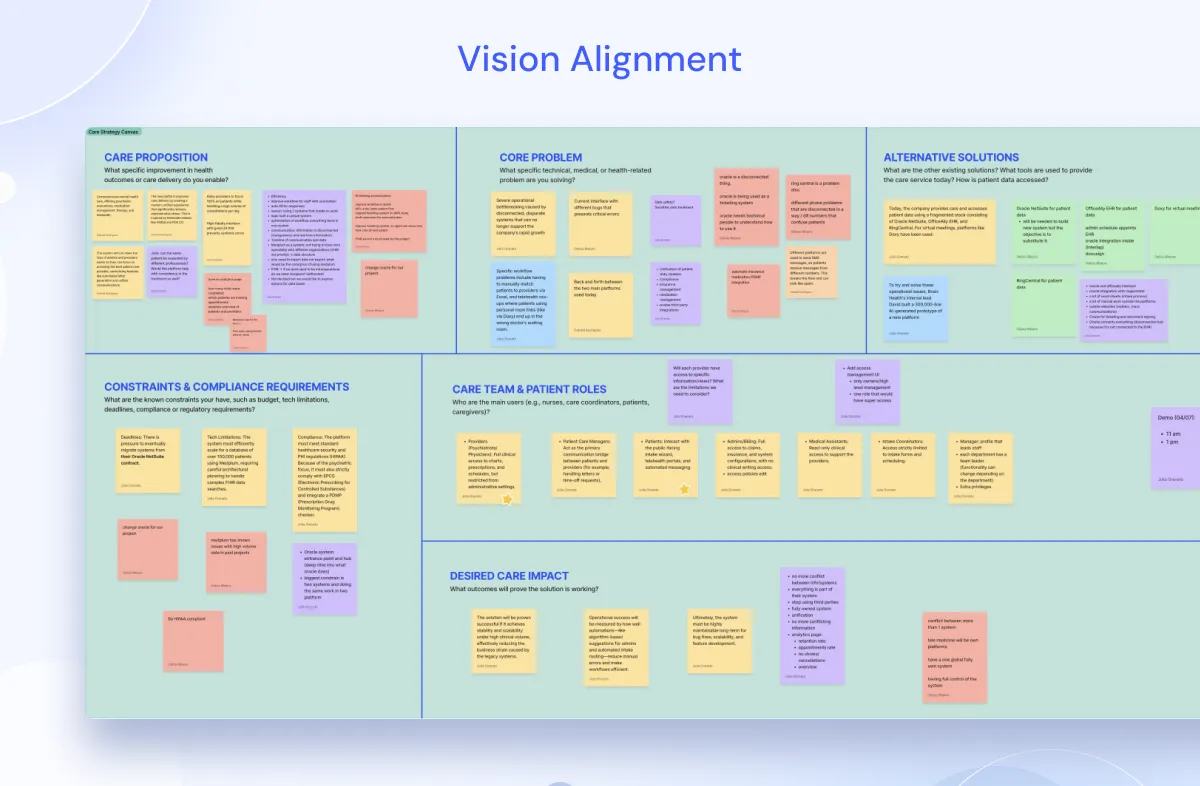
The Vision Alignment board: care proposition, core problem, constraints and desired impact.
Three findings shaped everything after:
- The main friction sits between intake, insurance verification and provider matching, spread across Oracle NetSuite, OfficeAlly and Excel with no unified patient view.
- Providers spend too long on documentation after each visit. At 30 to 40 telehealth sessions a day, without AI-assisted charting or support during the session, that becomes after-hours work.
- Billing has no automated denial tracking, which risks lost revenue at scale. Centralized claims management with guided workflows is the most direct fix.
Personas and the end-to-end user flow
We mapped five personas from the Brain Health team’s own operational knowledge: Provider, Intake Admin, Verification Specialist, Scheduling Admin and Billing Admin. Across all of them, the biggest pain was fragmentation: every role worked in at least two disconnected systems, with duplicate work, communication gaps and manual steps that bring clinical and financial risk.
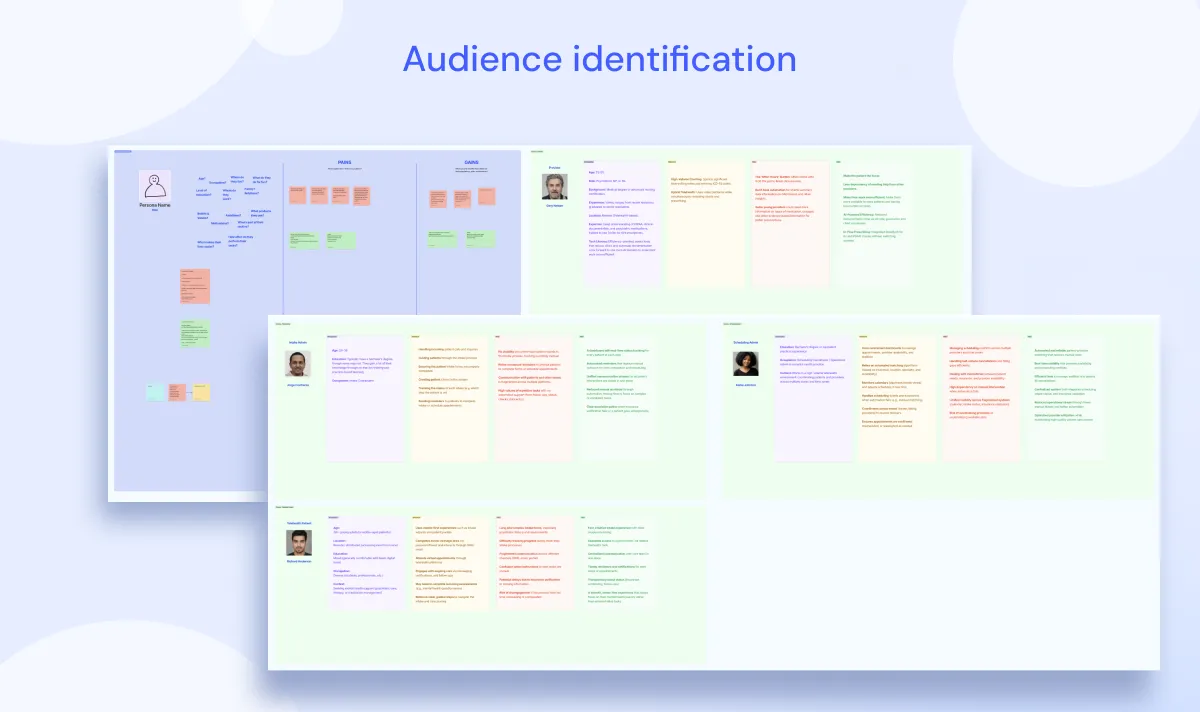
The five personas, each with their background, pains and gains.
The end-to-end user flow followed one patient encounter through the whole system: the intake link sent by SMS, the clinical visit with a structured psychiatric assessment, charting and prescription after the visit, claim submission and ongoing care. It showed the handoffs where the current stack carries the most risk, the same points that shaped the UX recommendations and the MVP scope.
Care Service Blueprint and UX recommendations
The Care Service Blueprint mapped what happens in front of the patient (intake, scheduling and billing admins), behind the scenes (provider workflows) and in external systems across the whole patient lifecycle: Stedi for real-time eligibility checks, DoseSpot for e-prescribing, Twilio for SMS and Health Gorilla for lab orders. With every dependency in one view, the team had a single reference for architecture and sequencing decisions.
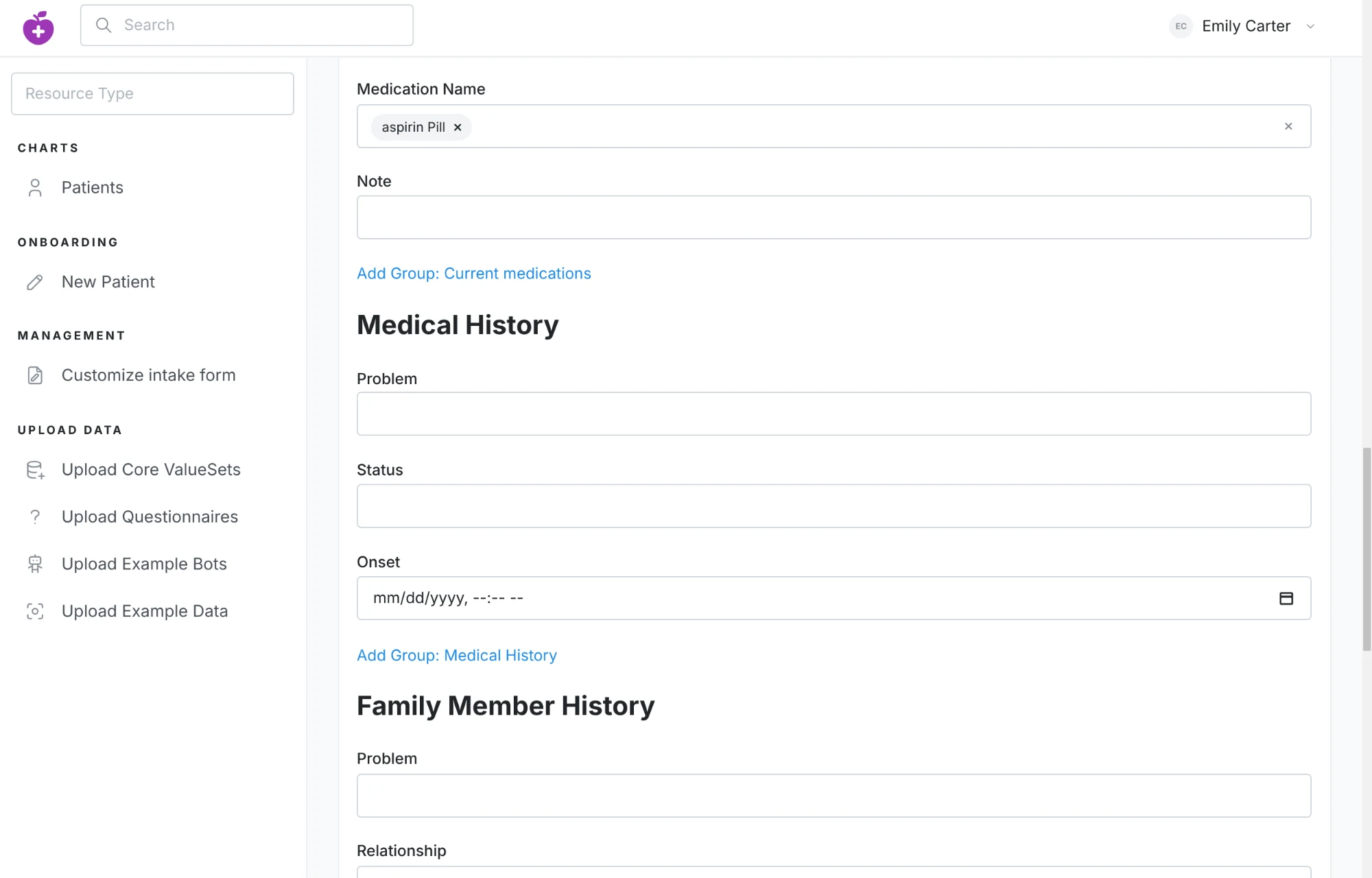
The UX recommendations fix the prototype’s worst usability problems before any new feature is built: broken scrolling in multi-step forms, navigation that hid whole areas from some roles, no visual urgency for items that need action now, and quick actions that sent users to another page instead of opening in place.
Technical assessment
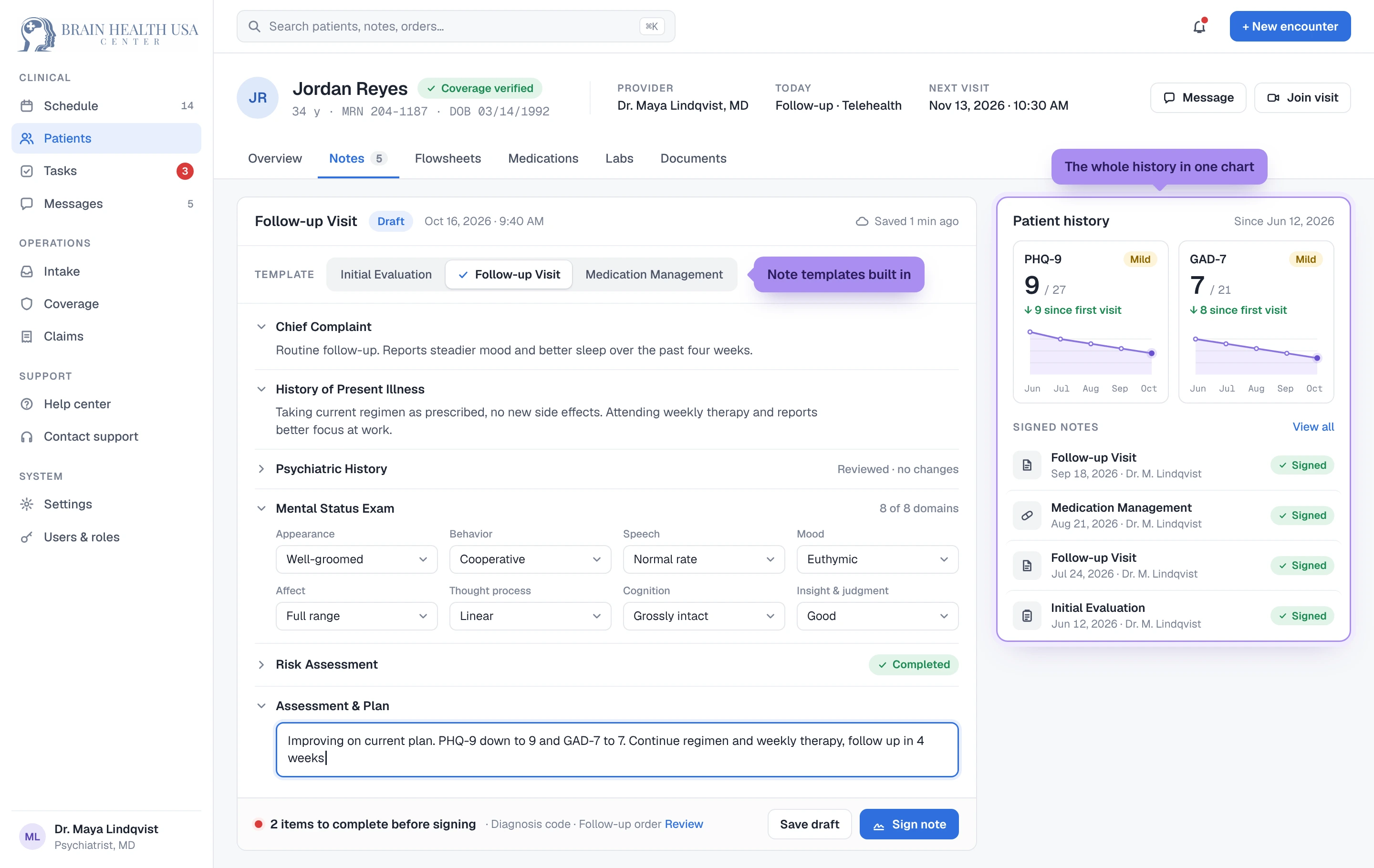
The technical assessment named the patterns in the codebase that wouldn’t hold under production load and made a clear recommendation: keep the prototype as a reference for UX flows, note templates, integration payloads and workflow states, and rebuild on Medplum’s native building blocks.
The case for Medplum is practical. Brain Health’s integrations already speak FHIR through Medplum’s built-in connectors: DoseSpot syncs prescriptions as MedicationRequest resources, and Health Gorilla writes lab orders as ServiceRequest and brings results back as DiagnosticReport.
Medplum’s hosted offering also covers compliance and infrastructure that would otherwise need dedicated hires and on-call coverage: a HIPAA BAA and SOC 2 posture out of the box, native AuditEvent and role-based access through AccessPolicy, encrypted storage, and event-driven automation with Bots and FHIR Subscriptions. Every capability on the MVP roadmap is easier to build on Medplum than without it.
The roadmap: an 11-month MVP in five phases
The roadmap organizes the build into five phases over an 11-month MVP, with a team of three developers.
Intake
~2 months
Appointment
~2 months
Post-care
~1 month
Billing
~1 month
Ongoing care
~3 months
Outcome: a path from prototype to production
The Healthcare Discovery gave Brain Health USA a validated foundation built around its people, and a build path grounded in how its clinics actually run rather than in the prototype’s assumptions. The AI-built prototype proved the ambition; the Discovery set out how to make it real.
With many patients and a growing provider network, there is no room for workflow errors. The scope, architecture decisions and integration order that came out of this work let the team start the build without the guesswork that usually drives EHR projects over budget.