- Map and shapeDays 1 to 5
- BuildDays 1 to 10, full flow by day 6
- Demo and handoffDay 10
What we did
- Healthcare MVP AI Fast-trackTen working days from the founder's idea to a working MVP he could show physicians.
- Medplum DevelopmentVinta EHR, powered by Medplum, gave the platform authentication, access control and a FHIR API on day one.
- UI/UX DesignA case workspace simple enough for physicians used to paper and email.
Built with
- Vinta EHR, powered by Medplum
- React
- TypeScript
- FHIR
- Vercel
- Claude Code


A stealth-mode startup is building software for physicians who perform independent medical examinations (IMEs), a niche that still runs on email, paper and phone calls. Its founder needed a working product to win over physicians. Through our MVP AI Fast-track, Vinta mapped the workflow with two founding physicians and delivered, in 10 working days, an MVP that runs an IME case from scheduling link to paid invoice, built on Vinta EHR, powered by Medplum, and deployed with synthetic data.
10 days
from kickoff to the final live demo and handoff.
2
founding physicians interviewed, at opposite ends of the IME market.
1
golden path, from the requester’s first request to the physician’s paid invoice.
About the IME Startup
The IME Startup is a company, still in stealth mode, building software for physicians who perform independent medical examinations (IMEs). An IME is an evaluation that attorneys and insurers request in injury and workers’ compensation cases, done by a physician who does not treat the person examined. The founder knows the IME market closely.
Most IMEs are done by physicians working on their own, often orthopedic surgeons, who take cases alongside their clinical practice or after retiring from it. Cases come from attorney offices and insurers they already know. Large platforms route cases to examiners, but none were built for the physician who runs a practice of their own.
The challenge: proving a niche product to skeptical physicians
An IME practice runs on email, phone calls and paper. Before writing a report, the physician reviews the claimant’s full medical history, which arrives as PDFs, mailed records or both, and can run to thousands of pages. The report has to hold up in court, and the physician may be called to testify about it.
The founder needed something real to put in front of those physicians, and slides or clickable mockups only go so far with surgeons who trust the system they built over a decade. The usual paths both had a cost. A full discovery followed by a months-long build would delay the first demo by months. Building it alone with AI coding tools gets screens running quickly, but those prototypes rarely survive the first real user, and they leave out what HIPAA asks of any product that stores health data: access controls, audit logs and business associate agreements with every vendor that touches it. That means a rebuild before the first real record goes in, and a data exposure in the meantime can bring federal penalties and cost the trust of the physicians the product depends on.
Turning the idea into an MVP in 10 working days came with five constraints:
One workflow
The service covers a single end-to-end path, so we had to find the one that proves the product.
Several voices, one decision
The two founding physicians work in very different ways. The founder needed one workflow that would fit both.
No time for a traditional discovery
Research and validation had to fit into the first week.
Users who aren't tech-savvy
Many examiners are older physicians who rely on paper, email and systems they refined over years.
Health data from day one
The product handles medical records, so the foundation had to be built for that from the start.
Our approach: mapping the IME golden path in the first week
We used the first week to agree on the single workflow the MVP would cover. Day 1 opened with a kickoff and a vision alignment session with the founder, where we filled in a Care Strategy Canvas covering the problem, the roles around a case, today’s tools and the constraints. On day 2 we mapped the full IME journey, from the first request to the paid invoice.
Later that week we interviewed the two founding physicians, whose practices sit at opposite ends of the market. We mapped how each of them runs a case today, including the different channels cases arrive through, and consolidated it into one golden path covering both sides of a case: the physician and the requester. We marked every step as MVP or later and locked the scope with the founder before the week ended.
The interviews changed the founder’s initial assumptions. He expected scheduling to be the main pain, but neither physician described it as one. Record review weighed the most, because packets arrive late, incomplete and without an index, and getting paid in full came second. The MVP gave both a dedicated place. The founder acted as the single decision maker, which let us bring the two physicians’ views into one scope.
RequesterSecure linkExamining physician
RequesterUploadsExamining physician
RequesterSecure reportExamining physician
RequesterCheck or ACHExamining physician
Left for future iterations: a requester portal, AI record indexing, dictation with e-signature, and online payments.
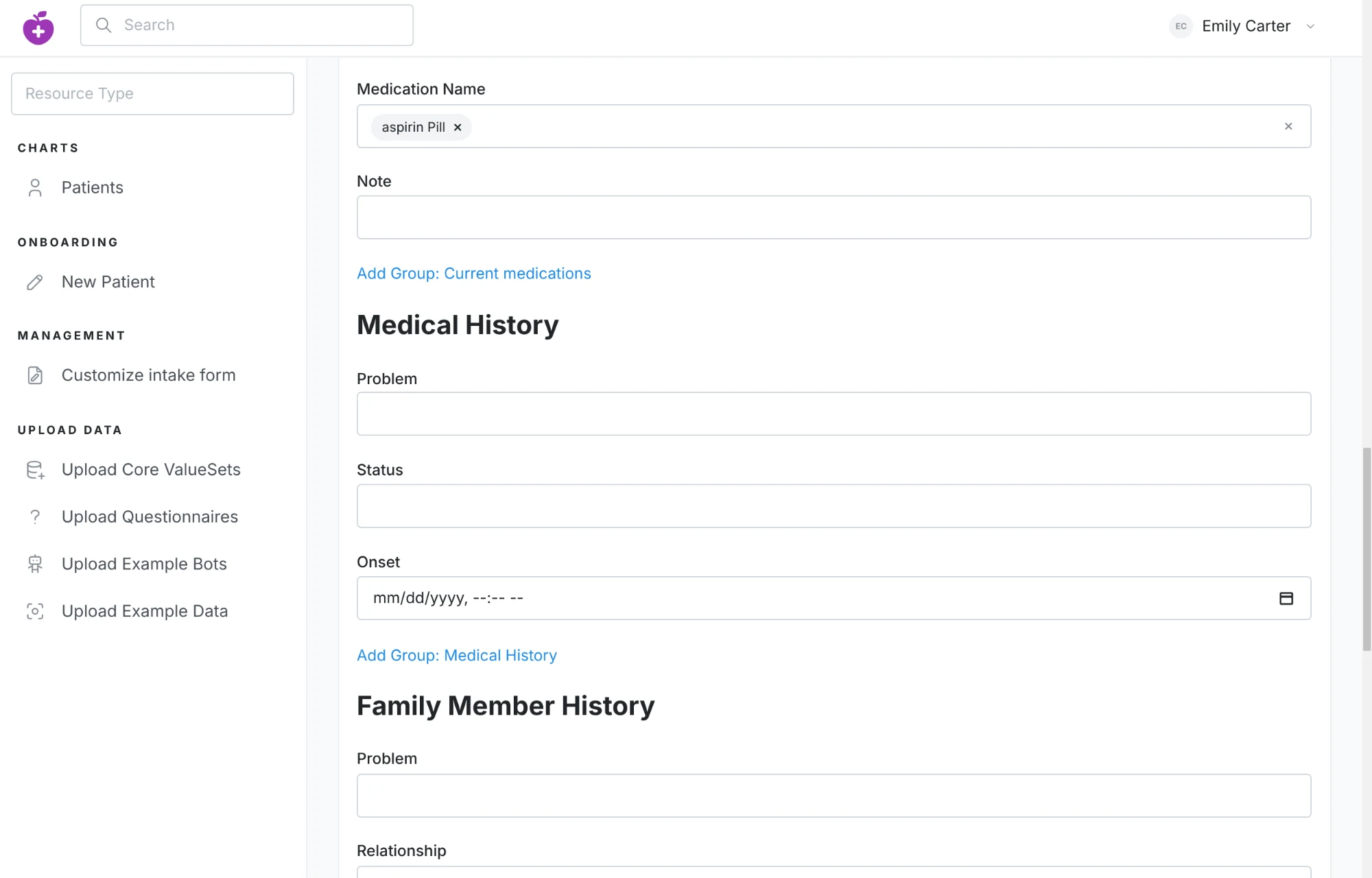
What we built on Vinta EHR
A foundation built for health data from day one
We built a custom case platform on Vinta EHR, our EHR foundation powered by Medplum. From Vinta EHR the MVP took the base platform, provider management, emergency access, and the groundwork for scheduling, charting and the case timeline, so the team could spend its time on what is specific to IMEs. Medplum runs underneath as the healthcare backend, with authentication, access control and a FHIR data model from day one, ready for a future requester side of the product.
Development started on day 1, in parallel with discovery. Our engineer used Claude Code with Vinta’s AI workflows, and our product manager ran discovery with an AI skill stack that turned recorded calls into the canvas, the journey map and the product requirements document. By day 6, the full case flow ran end to end, from case creation to the invoice.
For dictation and document intelligence, we chose proven third-party services over building our own.
What the MVP covers
The MVP covers an IME case from start to finish on the physician’s side. Requesters, the attorney offices, insurers and agencies that order IMEs, don’t need an account and act through secure links.
Setup, scheduling and records
Record review and case tracking
Report and billing
The opinion in the report is always the physician’s own, since it has to hold up in court. An automatic index of the records, by date of service, provider and page, is partly built and stays off until it is validated against real scans.
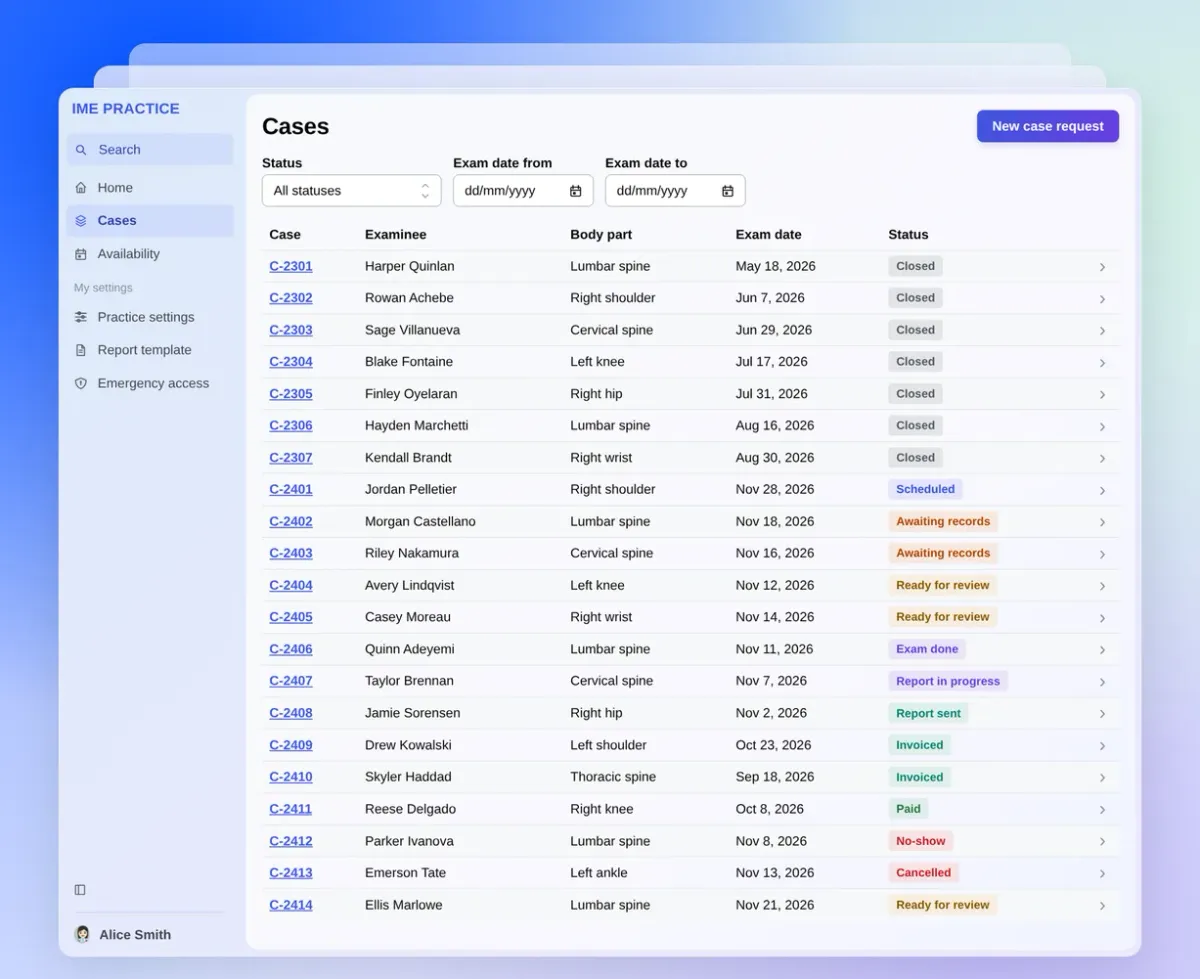
C-2404
Step 2 of 4 · ExamReady for review
- Overview
- Records
- Notes
- Report
- Billing
Case details
- Examinee
- Avery Lindqvist
- Age 36
- Exam
- Nov 12, 2026, 3:00 PM
- Today · Left knee
- Requester
- Harbor & Pike LLP
- dana.whitlock@
harborpike.test
- Records deadline
- Nov 5, 2026
- 7 days ago
- Cancellation deadline
- Nov 10, 2026, 3:00 PM
- Passed · 2 days ago
Timeline
Record uploaded
orthopedic-consult.pdf
Upcoming-exam reminder sent to you
Upcoming-exam reminder sent to the requester
Record uploaded
claim-form.pdf
Record uploaded
physiotherapy-notes.pdf
Records received
Awaiting records → Ready for review
Record uploaded
mri-lumbar-2025.pdf
Appointment booked
Scheduled → Awaiting records
Case created
Appointment
Nov 12, 2026, 3:00 PMToday
BookedInside cancellation window
The cancellation deadline has passed, so cancelling now can be charged as a late cancellation.
Pending items
New files uploadedYou
A case page with its deadlines, appointment, pending items and timeline. Recreated interface with sample data for anonymity.
Ten days with the founder
From day 6 on, we met the founder every day for a short check-in. Each one walked through what had changed since the day before, and his feedback went straight into the next round of work. One example is the progress tracker on each case, which replaced status labels he found confusing.
On day 10 we ran the final live demo with the founder and handed the MVP over.
Outcome: a live MVP and a plan for production
After 10 working days, the startup had a live MVP that covers the full IME case journey, from the scheduling link to the paid invoice. The founder can now put it in front of physicians and show the product working, instead of describing it. In the same 10 days, our designer also prototyped what a refined version could look like in the next rounds.
Along with the running system, he received:
| What he received | What it holds |
|---|---|
| Source code and a recorded walkthrough | Owned by the client from the first commit. |
| A product requirements document | What was delivered and what the second version would include. |
| A roadmap to the second version | Five milestones grouped by what each one unlocks, starting with the production readiness that gates a pilot with real data. |
| A prototype of the next version | A refined record review workspace, with an index sidebar and a timeline of encounters, for the physicians’ biggest pain, designed in parallel. |
1 / 3 · Scheduling
C-2404
Step 1 of 4 · SchedulingAvailable slots
- Schedule
- Details
Requester scheduling link
Verify your email
Pick a slot
- 9:00 · Fri
- 10:00 · Fri
- 11:00 · Fri
- 9:00 · Fri
- 10:00 · Fri
- 11:00 · Fri
- 9:00 · Fri
- 10:00 · Fri
- 11:00 · Fri
Choose an available time, then confirm your appointment.
2 / 3 · Report delivery
C-2404
Step 3 of 4 · ReportFinalized
- Overview
- Records
- Notes
- Report
- Billing
Finalized report
Finalized · read-only
History
Physical examination
Assessment
Secure link sent to requester
Expires in 7 days · code required
3 / 3 · Billing
C-2404
Step 4 of 4 · BillingOverdue
- Overview
- Records
- Notes
- Report
- Billing
Invoice
- IME exam
- $ —
- Record review
- $ —
- No-show fee
- $ —
Overdue
Three steps of a case: the requester’s scheduling link, the finalized report and the invoice. Recreated interface with sample data for anonymity.
Is the MVP AI Fast-track right for your idea?
The MVP AI Fast-track is built for founders bringing a new healthcare product to market, like this startup’s founder: a clear and narrow idea, a market they understand, little or no documentation and a reason to show something working soon. Having no spec is fine. Mapping the core workflow is part of the engagement.
This MVP took 10 working days because its scope fit a single golden path and the founder was available every day. Most Fast-tracks run four weeks, at one fixed price. In the first week we map your golden path with you and lock the scope, and by day 5 the first part of your product is already running. The following weeks build the full path, with a daily check-in. The sprint closes with a Reality Check of what is left before real patient data and a live demo, where you receive the code.
A good fit
- A clear, focused idea and urgency to show it to investors or first users
- Comfortable validating first and hardening for production in a second phase
- Available for a daily check-in and a few hours of meetings on day 1
- Can introduce us to the clinicians or users we need to interview in the first week
A better fit for a Healthcare Discovery or a dedicated team
- A long, detailed backlog to implement as written
- Full audit readiness or specific certifications required before any code is written
- Unable to commit to daily contact during the engagement
- Still exploring which problem to solve
See Healthcare Discovery and our dedicated teams.
Have a healthcare idea to prove? Our MVP AI Fast-track puts a working product in front of your first users in four weeks. When it is time to grow that MVP into a full system, our EHR development team takes it to production.