
9+years and counting
- Rebuilding the platformFrom 2017, and the firms moved over
- Growing the productWIPO, trademark watch, an acquisition
- AI in the productPlain English filtering, to today
What we did
- Dedicated TeamEngineers since 2017, now joined by a product manager and a designer.
- Django DevelopmentRebuilt the platform from scratch on Django, React and Postgres, then moved the firms onto it.
- Python Web DevelopmentFaster imports and deduplication across a 3TB database of US patents and trademarks.
- UI/UX DesignA redesign shaped by support tickets, and a mobile-first homepage with better SEO.
Built with
- Figma
- Django
- Python
- Azure Devops
- Azure
- Postgres
- Celery
- CircleCI
- Docker
- GitHub Actions
- Papertrail
- Redux
- React
- TypeScript
- Sentry
- NewRelic


Alt Legal makes the trademark docketing software that law firms and legal departments use to track their clients’ IP portfolios. In 2017, it needed to rebuild its product faster than it could on its own, and brought in Vinta. We rebuilt the platform from scratch on Django and React, deduplicated a 3TB database of US patents and trademarks, moved the firms onto the new system, and have built the product with Alt Legal ever since, from WIPO docketing to an AI filtering assistant. In its CEO’s words, Vinta sped up Alt Legal’s rate of development by over 50%.
50%+
faster development, says Alt Legal’s CEO.
3TB
of US patents and trademarks, imported and deduplicated without slowing the platform.
9+ years
building Alt Legal’s product, from the rebuild in 2017 to the features it ships today.
About Alt Legal
Nehal Madhani, a former insolvency lawyer, co-founded Alt Legal in 2013 and grew it for years without significant outside investment. It makes cloud software that IP professionals use to manage trademark portfolios: it connects to IP offices around the world, pulls in each matter’s data, calculates its due dates and keeps the portfolio in sync, with trademark watch, reporting and collaboration tools beyond the docket.
More than 2,000 law firms and legal departments use it, as Alt Legal’s site says. Its CEO was appointed to the USPTO’s Trademark Public Advisory Committee in 2023, and the company has grown through acquisitions and, in 2025, a growth investment led by SSM Partners:
Alt Legal founded
2013
Vinta joins
2017
MarkTend
2019
TM Cloud
2023
Growth investment
2025
WebTMS
2026
180+
jurisdictions whose IP offices Alt Legal’s platform connects to.
2,000+
law firms and legal teams use Alt Legal.
The challenge: rebuild the product while it grew
Alt Legal set its product apart with automation, simplicity and collaboration, and it grew fast. Growth brought its own problem: Alt Legal needed more developers to rebuild its product faster than it could on its own, while it kept shipping features, answering support and keeping the code clean and tested.
That is when Nehal Madhani, Alt Legal’s CEO, reached out to Vinta. He set three goals for the work:
Ship new features
Keep the product moving while the work went on.
Raise code quality
Clean, tested code that is easy to change.
Fewer bugs
Bring the bug count down, and keep it down.
Our approach: start over, beside the old
We start every project by inspecting the codebase: it shows which code needs refactoring and how the architecture holds together. At Alt Legal, the inspection showed that improving the existing code would take longer than building a new platform from scratch.
The decision touched the whole business, so we met with Alt Legal’s team to lay out the trade-offs. Starting over meant running two platforms for a while and moving the firms over gradually; in return, it brought better quality and the freedom to rethink what users needed. Alt Legal agreed, and we started the new platform on Django, React and Postgres.
A redesign based on support tickets
A confusing user experience usually leads to complex, nested code, so understanding how people used the product came first. During the first sprints, some of our assumptions needed checking, and the answers could change a lot in the new version.
Alt Legal’s support team, in touch with users every day, knew their struggles best. We created a board where every issue users raised could be examined by the whole team, and sorted the design backlog by urgency: what needed work right away and what could wait. The redesign cleared the way, made collaboration easier and streamlined tedious tasks, and showed which features users expected to be fully automated and which worked better by hand.
Deduplicating 3TB of patents and trademarks
While the new interface was designed, we made the platform’s automation and data imports faster. The system processes and stores huge amounts of data on a cycle: a database of about 3TB of US patents and trademarks. We had to deduplicate large chunks of that data without slowing the platform down, with Python and community-tested open-source tools.
What we learned became talks by Flávio Juvenal, one of our founders: on normalization at DjangoCon US 2018 and on record deduplication with Python at PyCon US 2020.
Moving the firms to the new platform
When the new system was ready for its first firms, we built a process to migrate users from the old one quickly and without mistakes. With Alt Legal’s success team, we agreed which clients would move first and at what pace.

Vinta Software sped up our rate of development by over 50%.
 CEO at Alt Legal

Nine years of new features
From four developers in 2019, our team grew into squads for the platform, the application and support, with a product manager and a designer, and has kept building the product with Alt Legal.
Moving TM Cloud’s customers
When Alt Legal bought TM Cloud’s docketing business in 2023, our team moved its customers onto Alt Legal’s platform.
WIPO docketing
International trademark filings tracked in one place, with every designation side by side, released in 2024.
Automated trademark watch
We built the automated reports behind Alt Legal’s §2(d) Trademark Watch and Trademark Application Match, which flag possible conflicts with a firm’s marks.
AI Filtering Assistant
Users type what they want in plain English and watch the filters fill in, instead of building the search field by field.
Beyond the product: a homepage that sells
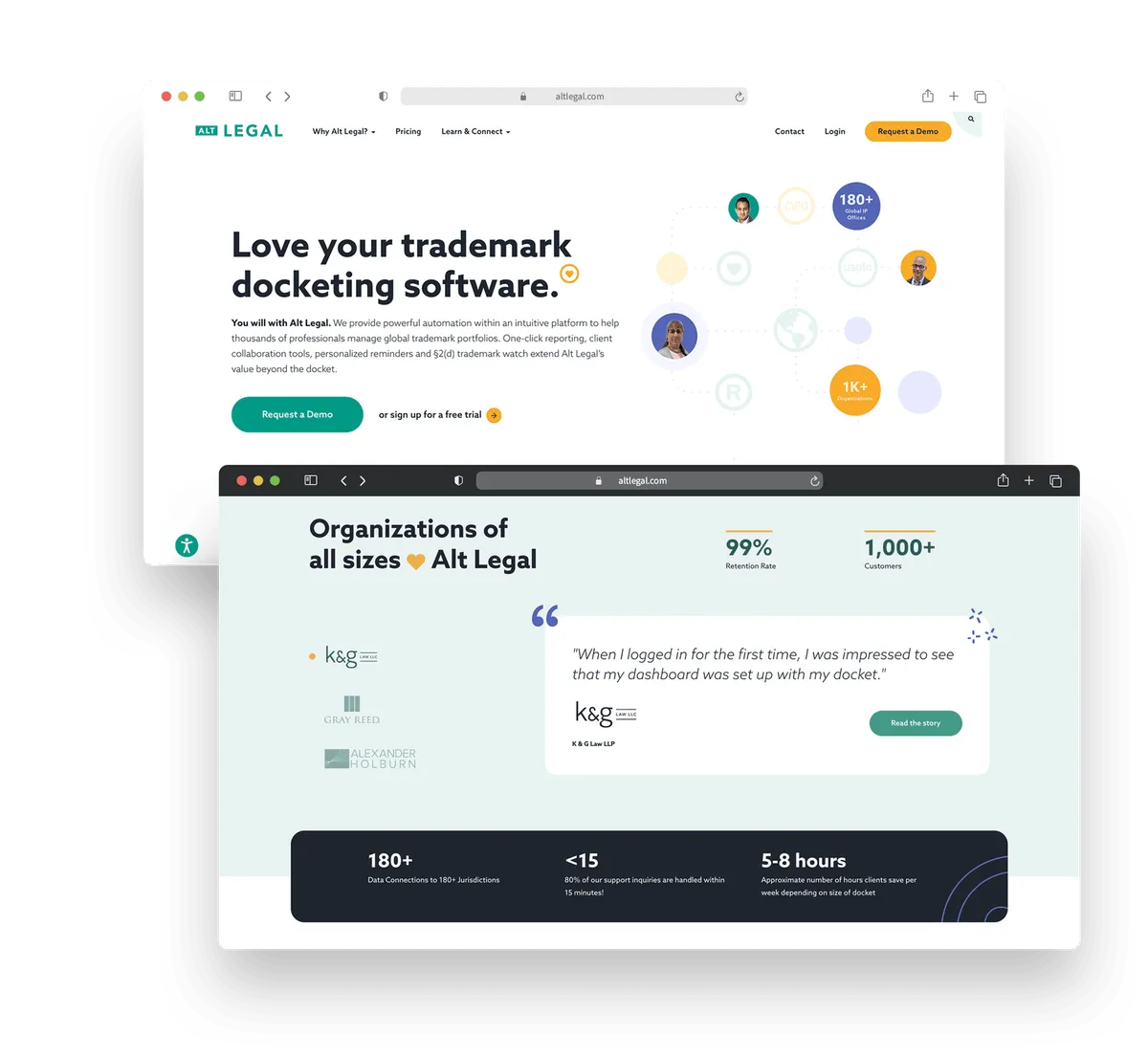
Once the migration was stable, we looked with Alt Legal at what else in its daily operation could improve alongside new features. The CEO wanted automation to help him demo and sell the product, and a homepage that converted better. We redesigned the homepage mobile-first, improved its SEO and added a heatmap tool, so user data could guide later design decisions.
A homepage like that needs a shared view of the sales process and the customer personas, where opinions often differ. We named each assumption and tested it instead of debating it, and that way of discussing as a team has stayed with us since.
Outcome: over 50% faster, still growing
With a new platform and a team that knows the business, Alt Legal’s development sped up by over 50%. Nine years on, the platform we rebuilt serves law firms and legal departments around the world, and keeps gaining features, from WIPO docketing to AI search.