Build vs. buy EHR: how to tell which one your practice needs

Beatriz BettaTechnology & Business

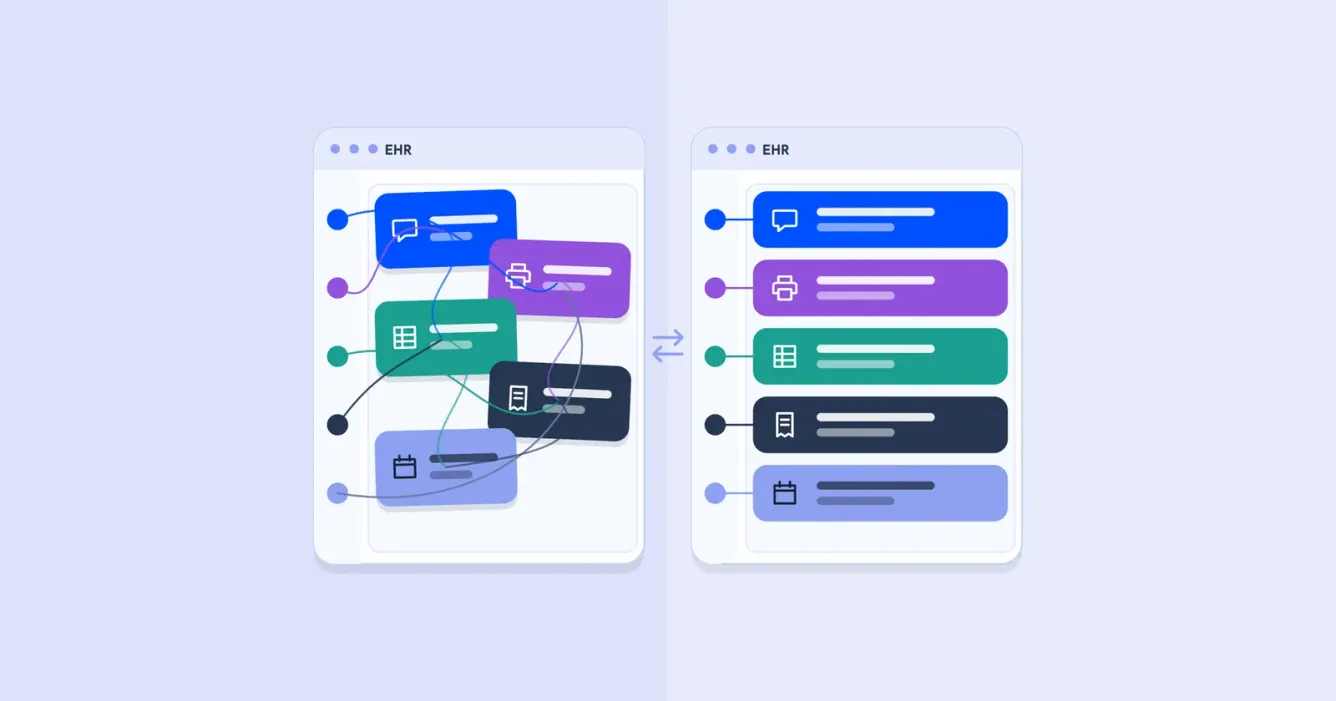
Most of the specialty clinic owners and medical directors I talk to never set out to have their own EHR.
They bought one, configured it carefully, and then started adding things beside it: a messaging tool, a fax service, a spreadsheet that tracks what the billing side never sees. By the time they reach us, each add-on has its own login and its own bill, and part of every clinic day goes into moving information between them.
The question usually arrives in the same words they would type into Google or ChatGPT: should we build our own EHR, or stick with an off-the-shelf one?
But actually a harder question is sitting right behind it. They have already paid for the current system, in money and in the months it took to get the team comfortable with it. Naturally, changing feels risky for the providers and staff who use the system at every visit, and some have already been through a vendor or a project that promised more than it delivered.
What they really want to know is whether the system they have can still carry the practice they want to run, and, if it can’t, what it would take to change systems without disrupting the clinic’s day-to-day.
I’ve been on the other side of that question in many calls, and the honest answer is rarely a clean yes or no. This article is how I’d answer it today, drawing on the build decisions we have made with clients and the ones we make on our own platform.
Is it cheaper to build or buy an EHR?
Buying almost always costs less upfront.
Over several years, the comparison depends on how far your workflow sits from the one the vendor designed for, and on how much your team spends working around that gap, which is why price alone rarely settles the decision.
Both paths cost money, time, and attention, and both leave you with constraints. The more useful question is where you want to absorb the complexity of running a healthcare operation: inside a vendor’s product and on its terms, or inside software you own and on yours.
Buying hands off much of that complexity to the vendor. Certification, upkeep, and the long tail of features most practices need sit with someone else, and in exchange you inherit the vendor’s assumptions about how a practice works.
Building takes the complexity back, along with the freedom to shape the system around your care model. So the decision comes down to which set of constraints you are willing to carry for the next several years.
Buying and building both carry complexity. The difference is whose terms it sits on.
When is buying an off-the-shelf EHR the right call?
When your workflow looks like the one the EHR was designed for, buying is usually right, and I tell practice owners so.
If your scheduling, notes, orders, and billing follow the patterns of your specialty, a mature off-the-shelf EHR gets you running quickly, with a vendor that manages maintenance, regulatory updates, and support.
For an early-stage founder who still needs to prove a care model, it can also be the fastest way to learn what the software actually has to do.
The cost shows up later, though, and the subscription is the smaller part of it. The larger part is the administrative burden that comes from the platform’s assumptions: the visit types it expects, the payment models it supports, the way it ties a patient to a provider and a claim. Every place where your practice works differently turns into manual work for your team.
Many of the teams we meet chose their EHR expecting to customize the parts of the operation that matter most to them, often on the strength of an API-first promise. Some get there by building add-ons, plugins, and integrations on top of the EHR, which can be the right path for a long time. Others discover that the APIs are too limited for what they need, and that gap is where the workarounds begin.
When does building your own EHR make sense?
Building makes sense when your clinical workflow is your differentiation and the EHR you run treats it as an exception.
Past that point, the system’s limits stop being an operational annoyance and turn into a limit on the care you can offer. If your workflow is standard, that point may never arrive, and staying put is the better decision.
The teams I’ve seen choose to build mostly shared the same trigger: their core product depended on workflows their EHR was not going to support anytime soon. At some point, waiting on the vendor cost more than building.
In day-to-day operations, that point tends to show up as a handful of signals:
- A step in your care model that the EHR can’t express, so it lives in a separate tool, a spreadsheet or someone’s inbox.
- Clinical and billing data that don’t meet, so notes stay open longer than they should and claims come back for reasons the clinic floor never saw.
- A stack of add-ons, each with its own login and contract, holding together a workflow the core system should own.
- Roadmap ideas your team has stopped proposing because everyone already knows the platform will say no.
Four signals that an off-the-shelf EHR has become a limit on the care model.
Everself, an obesity care platform that pairs medication programs with endoscopic procedures and remote follow-up between visits, reached this point after launching on off-the-shelf tools.
Those tools were a reasonable way to start quickly. As the model matured, the team faced the classic build vs. buy decision and chose to build a provider portal on Medplum, consolidating clinical workflows, patient context, and communication in one place.
We delivered it in phases, starting with the operational layer the team relied on every day. Their former Head of Product described our approach as “only recommending we build what’s really necessary”, which is the part I’d underline for anyone weighing a build.
 Case study · Chronic DiseaseEverself’s care team sees every call, lab and visit on one timelineRead the case study
Spotting the inflection point is one decision. Leaving your current system safely is a separate one, and it needs its own plan; we covered that in EHR migration: why leaving your current system feels so hard. If you are still mapping where your current platform falls short, the hidden gaps of off-the-shelf EHRs in specialty care article goes deeper on that.
What does building your own EHR ask of you?
First, clarity before code. In the builds that went well, the team knew early which parts of the product set them apart, and that is where most of the custom work went.
Scheduling and intake follow well-known patterns by now, so a team that knows healthcare can move through them quickly with AI in the loop. The pain came from what showed up late: integrations and compliance decide so much of the architecture that we are used to putting them on the table in the first weeks of a project.
Second, a willingness to own software. A custom EHR is yours to run, update, and extend, which is the reason to build it and also the commitment you sign up for. Someone has to answer for uptime, audit trails, vendor contracts, and the next regulatory change.
With a specialized partner, you don’t need an in-house engineering team for that, but you do need someone on your side who makes product decisions and keeps making them.
This holds for a system you built years ago, too. A homegrown EHR carries the decisions made when it was first written, and after enough years the question can shift from build vs. buy to whether to keep patching what you have or rebuild it on a modern foundation.
Quilted Health reached that point with Maternity Neighborhood, its own EHR purpose-built for midwifery and in continuous development for more than 14 years. The system delivered the core of the practice, but tight coupling and outdated dependencies made even small changes slow, and it had no native FHIR support.
After a careful evaluation, modernizing that codebase proved riskier than rebuilding, so the team rebuilt on Medplum as a foundation instead of continuing to hand-build every layer.
 Case study · Maternal CareLabor and delivery, charted liveRead the case study
The last risk is overbuilding. A practice that finally escapes a constraining EHR often wants to fix every frustration in the first release. The builds I’d point to as models started with the workflow that hurt most and added the rest once that first piece was in daily use.
Can AI-generated code get you to a production EHR?
It can get you to a solid proof of concept faster than ever, and that has real value. More founders now arrive with a vibe-coded app that shows their vision better than any slide deck.
What a proof of concept doesn’t carry is exactly what a production EHR needs: HIPAA-ready safeguards and a compliance posture you can document, security controls such as server-side access rules and complete audit trails, tested integrations, and a codebase someone can maintain next year.
So yes, AI does shorten the build when it works inside a codebase designed for it, and the operational and regulatory responsibility stays with whoever runs the software.
A proof of concept shows the vision. Production adds the layers clinical software has to carry.
What should you build and what should you buy inside an EHR?
Decide layer by layer. Build vs. buy is rarely one decision for the whole system; it is a series of smaller ones, and getting them right is what keeps a custom EHR affordable to build and to run.
We apply the same criteria to our own platform work. A capability is a candidate to buy or integrate when it doesn’t set you apart, when mature vendors offer stable APIs for it, or when a specialist vendor is better placed to carry its regulatory or clinical liability. It is a candidate to build when your care model differs there, or when no vendor handles the healthcare-specific case well.
How we usually split an EHR between buying, starting from a foundation, and building.
How we usually split an EHR between buying, starting from a foundation and building:
| Layer of the EHR | Usual decision | Why |
|---|---|---|
| Clinical data store, FHIR APIs, authentication, audit infrastructure | Start from a solved foundation | Hard to get right and nearly identical across practices; a headless EHR or healthcare developer platform covers it |
| E-prescribing, clearinghouse, lab orders, ambient AI scribe | Buy or integrate | Mature vendors exist, and they carry liability you would otherwise take on |
| Scheduling, intake forms, patient messaging | Start from a foundation, then configure | Well-known patterns that still need your visit types, rules and roles |
| Clinical notes, care plans, the workflow your model depends on | Build | Clinicians feel this layer at every visit, and it is where your care model lives |
One more rule from our own decision register: cost can veto a build, and it should never be the reason for one.
If building a layer costs more than you can sustain, that settles it. If building it is merely cheaper than a vendor’s fee, that is a weak reason, because the layer becomes yours to maintain for as long as you run it.
Starter EHRs, headless FHIR platforms, and open-source reference apps deserve a note here. They are a real shortcut, and we build on them often.
They are also starting points by design. When we looked at why clinicians describe a starter provider app as “not an EHR”, the gaps clustered around the note: no structure or templates, diagnoses and orders kept in separate tabs, and no sign, lock, and addendum lifecycle.
Accepted EHRs have all of those. Treat a starter as the foundation, and plan the clinical layer as the part you will make your own. If you are comparing foundations, our overview of headless EHRs is a very useful next read.
So which one does your practice need?
Our final take depends on where you are today, and most practices fit one of three situations.
If your workflow matches your specialty’s standard and the add-ons are few, your current EHR is probably still serving you well, and staying with it is a sound choice for now. Your next renewal makes a good checkpoint: list what the system can’t do, and see whether that list is growing or holding steady.
If you run an operation whose workflow is what sets you apart, and the EHR has become the ceiling, plan to own that layer.
Start with the workflow that hurts most, beside or on top of what you run today, and move the rest in phases so care never stops. That is the work our EHR development and modernization team does every day.
If you want the speed of an off-the-shelf launch without renting the system your practice depends on, there is now a path between the two. Vinta EHR is an EHR our team configures for specialty clinics from our own foundation, and your practice owns the code from day one, so it can grow with your care model. It fits practices that can start from a proven structure; heavier customization, complex integrations and migrations of an existing operation go to a dedicated team.
Most practices fit one of three situations, and each points to a different next step.
Frequently asked questions
Is a custom EHR realistic for a small specialty practice?
More than it used to be. Much of the foundation (clinical data storage, FHIR APIs, authentication, audit) is already solved by developer platforms, so a small practice can start from it instead of reinventing it. You also don’t need an in-house engineering team, since healthcare-specialized partners can carry the build. What you do need is clarity on which workflow makes your practice different.
What is the option between off-the-shelf and a full custom build?
Building on a headless EHR or a starter EHR. You keep a proven data foundation and shape the workflows on top of it. It shortens the build considerably, as long as you treat the starter as a foundation and plan the clinical layer (notes, orders and billing) as the part you will adapt to your practice.
How long does it take to build your own EHR?
It depends less on the EHR itself than on scope: how many workflows you need on day one, which integrations they depend on, and whether you are migrating a running operation. Starting from a solved foundation and phasing the rollout shortens the time to the first workflow in daily use. Ask any partner for an estimate tied to a scoped first phase.
Can I build my EHR myself with AI coding tools?
Use them to build a solid proof of concept and to validate your workflow. A production EHR adds HIPAA-ready safeguards, security controls such as server-side access rules and audit trails, tested integrations, and a maintainable codebase, which call for a team that has run clinical software before. AI makes that team faster, and the responsibility for running the software safely stays the same.
Related articles
Article · 8 min read
The hidden gaps of off-the-shelf EHRs in specialty care
Why specialty care outgrows ready-made EHRs, and how modernizing extends their value.
8 min read

Article · 13 min read
EHR migration: why leaving your current system feels so hard
Why off-the-shelf EHRs make leaving hard, and how a phased migration lowers the risk.
13 min read